
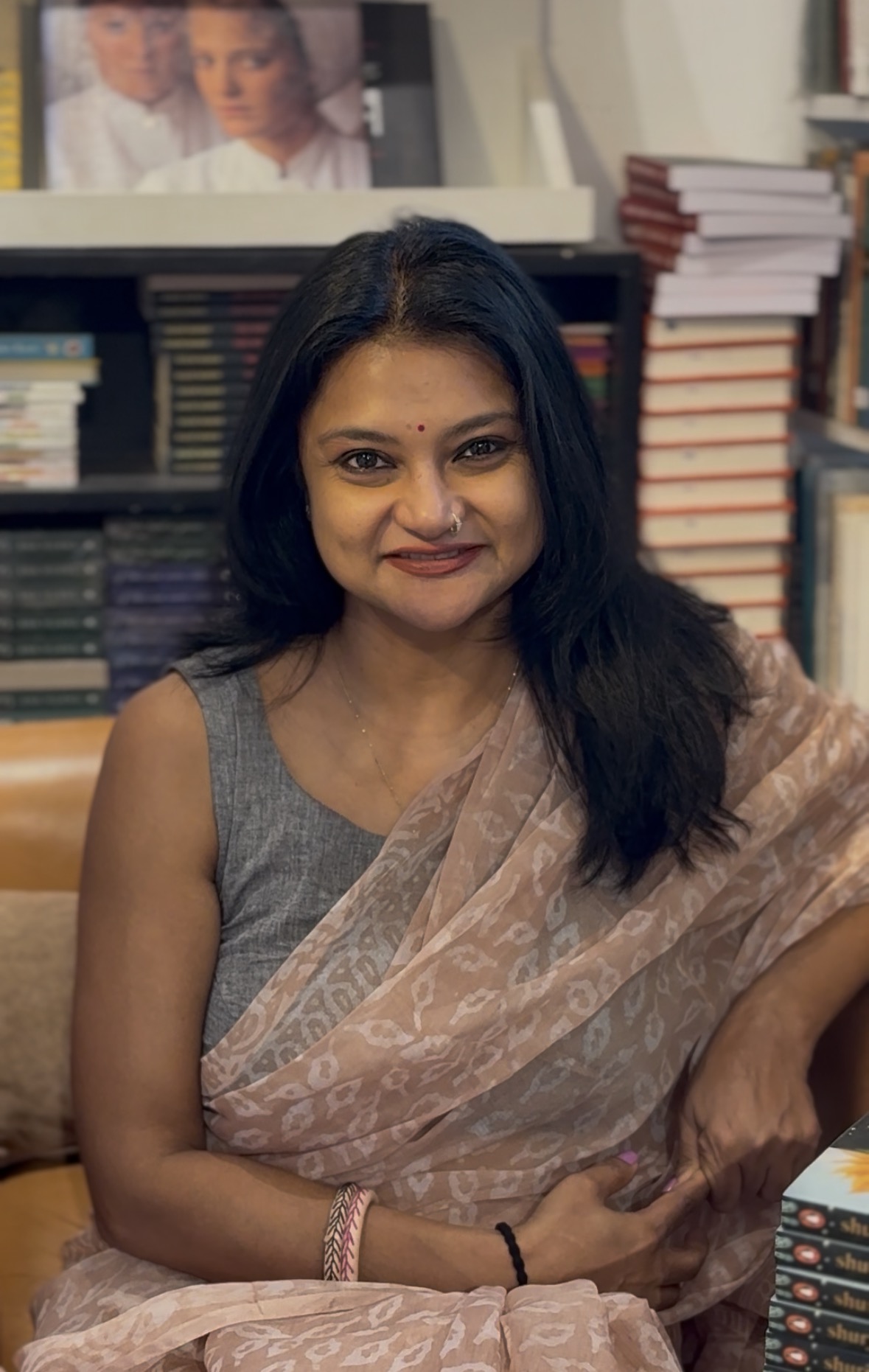
In a conversation that moves fluidly between memory, identity, womanhood, and the lingering weight of history, author Iffat Nawaz reflects on the emotional truths that shape both fiction and selfhood.
Iffat Nawaz doesn’t just walk into a room; she brings an entire atmosphere with her – one that feels slightly detached from the impatient, dust-choked anxiety of Dhaka. We meet at Bookworm Bangladesh on a characteristically chaotic afternoon, with the Justice Shahabuddin Ahmed Park pressing impatiently against the bookstore’s glass walls. Inside, however, there are cats, filtered light, and the peculiar intimacy reserved for places built around books.
She is in town for a breath, between Pondicherry, where she now lives, and a scheduled booktalk at Bookworm’s Tu’do branch the next day about Shurjo’s Clan, her acclaimed novel steeped in memory, war, and familial haunting. Over the next hour, our conversation unfolds in much the same way as her writing does – wandering elegantly between the personal and political, the spiritual and deeply ordinary.
1) As a writer, do you find that memory acts as a reliable narrator, or is it more of a creative collaborator?
I don’t think memory is ever a reliable narrator. Memories are always what we want them to be; they are shaped by how we choose to remember. You and I will remember this conversation in entirely different ways because you can never truly see through another person’s eyes. It takes a full 360-degree view to see the whole truth, and none of us have that.
Memory is tainted by emotion, mixed up with our relationships, and how we love – or don’t love – the people involved. So, it is absolutely a collaborator. For me, emotional memory was the food for this book. It wasn’t just about the home I grew up in, but the atmosphere of Bangladesh and Dhaka at that time. I can rely on the feeling of a place more than the literal facts. I know the smell of it; I know the pulse. That emotional truth is much more reliable than a sequence of events.
2) Do you find that identity is something a woman discovers in solitude, or is it something she performs for her community?
We are born with a core identity. You can see it in children, that distinct personality, whether it’s stubbornness or compassion. But then culture and religion start layering things on top. We borrow shiny things to perform for others; it feels good to be spiritual one day or fashionable the next. But to hear yourself, solitude is essential.
I’ve done Vipassana courses – ten days of total silence and ten hours of meditation a day. In that silence, you realise you’ve put on an identity like a costume, and you’re stuck acting it out because it’s a narrative you’ve been carrying. It’s a heavy burden. When I walked out of my first course in Hawaii, I was a different person. I felt lighter, as if I’d just watched a movie of my own life and finally seen the parts that weren’t actually mine.
3) The house in your novel is described as asymmetrical. How much of the female experience in the subcontinent in your opinion is defined by that same lack of symmetry?
For women, it is a very jagged world, for sure. It’s more questioned now than ever what it means to be a woman in Bangladesh. There’s this confused space of feeling angry, wanting to protect other women, and still trying to just be yourself.
I actually grew up in an asymmetrical house like that in Old Dhaka. My grandfather just added bits whenever he felt like it – “I need a door here, so I’ll put one here.” A friend of mine, the photographer Munem Wasif, once mentioned how the structure of a house you grow up in affects your thinking. If there’s a step up here and a bend there, you start dealing with life in that same manner. You learn to take more turns. Perhaps that formed me. Even as a woman, I think I am pretty asymmetrical too – just like my clan.
4) How do you define the difference between care as an act of agency and care as an inherited obligation?
It’s a difficult equation. When you look at things like mob mentality or even wartime situations, individual agency often shuts off and something else takes over. People give their lives for a cause they feel is bigger than them, whether that comes from family obligation, a debt to the nation, or a genuine wish for change.
I find it interesting that people can reach a point where they believe a cause is worth more than their own existence. Personally, I haven’t come to that point with anything. And we can’t really ask the heroes about the difference, because most of them are gone. Those who survived and wear the label of hero probably won’t admit if they were actually terrified or didn’t want to be there. I haven’t solved that one yet.
5) When you look at your earlier columns versus the fiction you are writing now, what is the one question you’ve finally stopped trying to answer and started simply allowing to exist?
My columns were like a quick purge – diverse subjects, very much of the moment. But with fiction, I was finally able to settle some scores with my history and 1971. I had been carrying that narrative – my family’s involvement, my uncles, the war – around as an identity.
I’ve stopped worrying about what those stories mean for the country or my family. I have found closure there. Now, the questions I allow to exist are my own. I’m looking at the broken bits that belong solely to me, not the ones inherited from a war or a previous generation. I’m writing about a woman working with refugees now – someone who is broken herself but is figuring out why the most damaged people are often the ones who end up helping others.
6) If you could sit at the dinner table with your characters, what is the one thing you would ask them that you were afraid to answer in the book?
I would just ask them if they are happy where they are now. When I was young, I felt the presence of my uncles so strongly because their pictures were always on the wall. But since finishing the book, that presence has faded. They’ve gone somewhere into the pages. I don’t know if they will return to me, but I’d like to know if they’ve found some peace, as I have.