
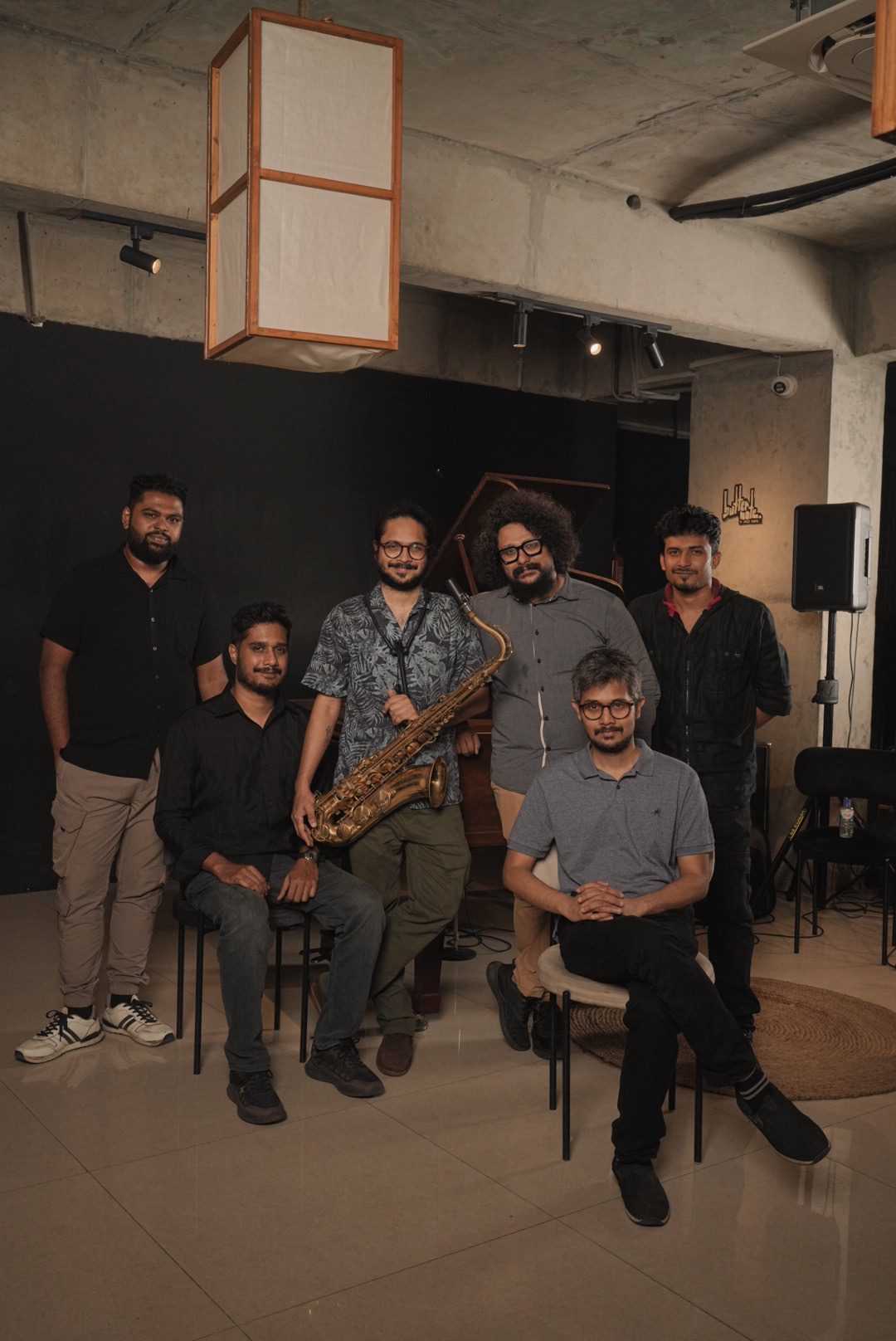
Dhaka’s music scene runs loud and fast, but the Seesaw Collective is moving in the opposite direction, embracing space, patience, and the tension between notes.
It is a common misconception that jazz in Dhaka is a pursuit for the quiet or the overly academic. In a city that usually prefers its music loud and its motives obvious, the Seesaw Collective is a rare exercise in restraint. The Seesaw moniker was originally a metaphor for the back-and-forth of a duo, a lean setup where Rahin and his brother, Jishnu could trade riffs in a vacuum. That intimacy expanded once Samiul’s drums and Raj’s bass entered the fray, pushing them into quartet territory.
They tried the four-man discipline for a minute, but the music was already leaking out of the corners. Every live set became an excuse to pull another body into the mix, another texture into the fray, until the boundary finally snapped. “The word ‘quartet’ began to feel restrictive,” Rahin tells me, explaining the transition. It’s a classic move for a group that views membership as an open-door policy. They traded the safety of a fixed roster for the beautiful, unpredictable chaos of a collective because, quite frankly, a duo or quartet was never going to be enough to hold a sound this expansive.
The backstory is a familiar one for anyone in the local industry. Rahin Haider, Jishnu Haider, Alistair Sarkar Raj, and Samiul Wahid are all seasoned session musicians, the reliable hands behind the scenes of Dhaka’s biggest acts. But in 2018, the Haider brothers found themselves sitting on a pile of instrumentals that required more than just two sets of hands. Timing did the rest.
“As luck would have it, Samiul and Raj were looking to form a jazz fusion project at the exact same time,” Jishnu says. They jammed once, and the chemistry was instant. Last year, they added Zahin Rashid on guitar, rounding out the sound of a band that functions as a safe space where ideas are tossed around without the usual ego-driven friction of a typical band.
One of the more distinctive elements of their sound is Rahin’s decision to incorporate the bansuri alongside the saxophone. In jazz, the saxophone is the expected; the bansuri introduces something less predictable.
“Technically, it’s a much more demanding instrument for me,” Rahin admits, noting that the saxophone is far more accommodating when it comes to chromatic playing which is the bread and butter of jazz. Currently, they only have one composition dedicated to the flute, Meena’s Desires, but it serves as a glimpse into a future where the local sound is defined not just by Western theory, but also rooted in the tonal textures of the region.
When the time came to record their debut album Maybe in 2020, the group chose an approach that reflected their live sensibility. Rather than constructing the songs piece by piece in a studio, they recorded the material live over two days at Samiul’s practice space. “The real challenge was switching off our analytical brains,” Samiul recalls.
By that point, the songs had already been shaped through repeated performances. The recording process simply captured that interaction in its most immediate form. Looking back at those tracks six years later, they view them with the fondness of a craftsman looking at old wood. “We feel our execution has matured,” Raj says, explaining how they now let those early songs breathe during performances.
One of their most notable releases, Bhanga Chand, demonstrates how effectively the Collective can bridge different sensibilities. It features the melancholic, retro-tinged vocals of Rupakalpa Chowdhury, but its origins lie elsewhere. The lyrics were written in a single sitting by Zahid Haider, Rahin and Jishnu’s father, and were initially intended for Shayan Chowdhury Arnob. “I loved the lyrics so much that I decided to keep it for the band instead,” Rahin confesses. It was a wise heist. The track resonated because it tapped into a niche that had been largely ignored, where surreal Bengali poetry meets the introspective nature of jazz.
Audience response has reflected a growing appetite for that kind of experimentation. Whether at Jahangirnagar University’s Him Utshab or in more intimate venues like Satori Academy of Arts, listeners have engaged with the music in a way that suggests something deeper than casual interest. There is a hunger for this kind of sound, even if the marketing hasn’t quite caught up yet. At the same time, the band is aware that their music is best suited to smaller, more interactive settings. “Our music is best experienced live, preferably in smaller rooms,” Zahin explains. “It’s really an intimate genre.”
As we wrap up, the conversation shifts to the future. The material is there; they have a dozen unreleased tunes that have already been road-tested. The only hurdle is production quality. The band wants the next record to surpass the last, aiming for a new album by the end of this year.
What sets the Seesaw Collective apart is not a desire to replicate or preserve jazz in its traditional form. They aren’t interested in being overly intellectual or academic either. They are simply musicians who have figured out that if you listen closely enough to the people playing next to you, the music usually finds its own way home.