
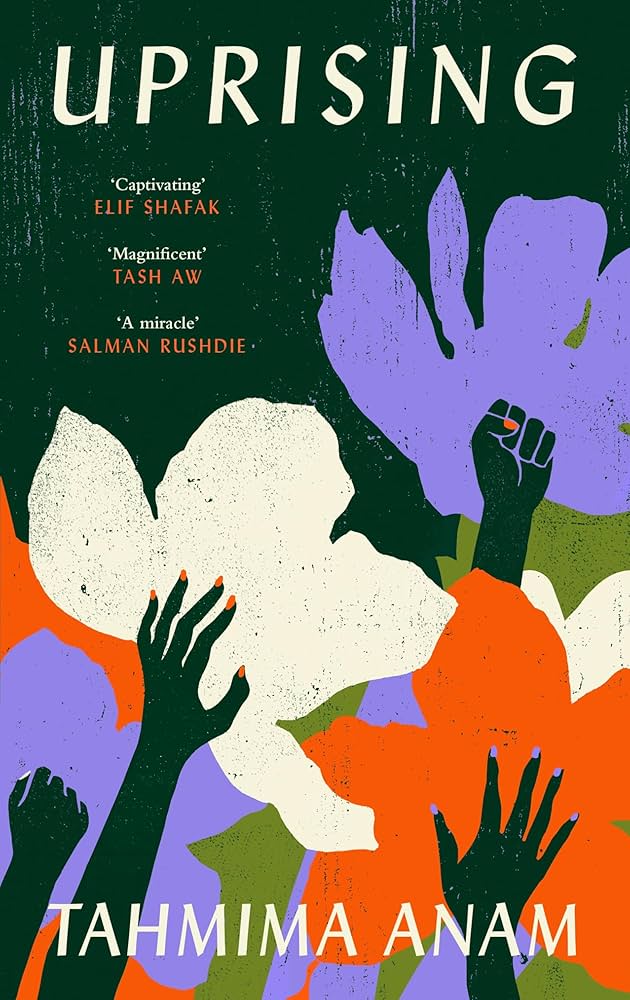
Set within the confines of an island brothel, Uprising is a finely wrought meditation on power, inheritance, and the fragile architectures of resistance.
Isolation is the primary currency of Tahmima Anam’s new novel, Uprising. On an island, where the boundaries between home and prison are indistinguishable, Anam constructs a world that feels both hauntingly claustrophobic and globally resonant. This is a novel of narrative economy and moral friction, proving that the most profound interrogations of power often happen in the smallest, most invisible spaces.
The novel unfolds on an isolated island brothel, a setting that immediately establishes both physical and psychological confinement. Women and girls here exist within a system that is at once intimate and institutional. Their confinement is maintained not only by force, but through the quiet persistence of habit, fear, and the slow erosion of alternatives. At the centre of this world is Amma, the brothel’s madam, whose authority is both absolute and disturbingly complex. Anam resists the temptation to render her as a one-dimensional antagonist; instead, Amma emerges as a figure shaped by her own history of violence and deprivation, perpetuating the very structures that once ensnared her.
What distinguishes Uprising is its attention to perspective, particularly that of the children who inhabit this environment. Anam writes them with remarkable sensitivity, capturing the way they interpret the adult world through fragments such as gestures, silences, and routines. Their understanding of intimacy is especially poignant. For instance, the simple act of having their hair combed or oiled becomes a form of tenderness that stands in stark contrast to the transactional relationships surrounding them. These moments are rendered with a quiet lyricism that offsets the novel’s harsher realities, allowing the reader to grasp not only what is lost, but what is still, tenuously, desired.
As the narrative progresses, the arrival of Kusum Khan introduces a subtle but decisive shift. Kusum is not a conventional savior figure; rather, she functions as a catalyst, her presence unsettling the fragile equilibrium of the island. Through her, the possibility of resistance begins to take shape. This does not appear as a grand, sweeping rebellion, but as a series of small, deliberate acts of awareness and defiance. The use of a lost mobile phone as a tool of both connection and strategy is particularly striking, symbolizing the intrusion of the outside world into a space designed to remain closed. It is through this device that the women begin to reimagine their circumstances, not as immutable fate but as a system that can, however precariously, be challenged.
Anam’s prose is disciplined and unadorned, a stylistic choice that serves the material well. There is no excess here, no indulgence in melodrama. Instead, the writing maintains a steady, almost clinical precision, allowing the emotional weight of the story to emerge organically. This restraint is especially effective in scenes of violence or coercion, which are conveyed with a matter-of-factness that underscores their normalisation within the characters’ lives. The result is a reading experience that is deeply affecting without ever feeling manipulative.
In essence, Uprising is a study of systems, specifically regarding the mechanics of their construction, their self-sustenance, and their eventual dismantling. The brothel is not presented as an isolated aberration, but as part of a broader network of social, economic, and patriarchal forces. Anam gestures toward the complicity of the state, the role of poverty, and the ways in which exploitation is both visible and obscured. This wider context enriches the narrative, preventing it from collapsing into a purely individual drama and instead situating it within a larger, more troubling reality.
Yet the novel is equally concerned with the interior lives of its characters. Amma’s contradictions, the children’s tentative hopes, and the women’s evolving sense of solidarity are all explored with nuance. Anam is particularly adept at depicting the slow, often uneven process by which individuals come to recognize their own oppression. Change in Uprising is neither immediate nor guaranteed; it is fraught with risk, hesitation, and the ever-present possibility of failure. This refusal to offer easy resolution is one of the book’s greatest strengths.
The climax of the novel brings these tensions to a head, as the women confront both Amma and the system she represents. Without revealing too much, it is enough to say that Anam resists tidy conclusions. The cost of resistance is made clear, and the aftermath is marked by ambiguity rather than triumph. This choice reinforces the novel’s commitment to realism, acknowledging that liberation, when it comes at all, is rarely complete.
In the end, Uprising stands as a powerful and necessary work, precisely because it forces a confrontation with uncomfortable truths. It simultaneously identifies a form of resilience that persists in even the most constrained circumstances. Tahmima Anam has produced a novel that is both intellectually rigorous and emotionally resonant, a combination that is all too rare. It is a book that demands attention, not only for its subject matter but for the precision and care with which it is rendered.