
Prothom Alo turned an arson attack against them into an art installation. For visitors to the exhibit, it was a catharsis.
The title above, although it sounds very much like a cliche, would not have been inappropriate for the Prothom Alo exhibition that concluded earlier in March in the very Prothom Alo building which was set ablaze by an organised mob on the night of December 18, 2025. The exhibition was open to the public from February 18, 2026 to March 02, 2026.
Titled “Alo,” a play both on the newspaper’s name and symbolic of the hope that it aspired to, this powerful and unique “site-specific” exhibition attracted hundreds of visitors everyday. I was among them. When I entered the exhibition site I had no idea what to expect; when I left the building an hour later, I was almost teary-eyed, uplifted by the message of hope and light of the experience inside.
“Alo” literally sprang up from the ashes of a vicious arson attack on the five-storey Prothoma building in Karwan Bazaar. I was familiar with the building – which was earlier the office of The Daily Star where I used to go often two decades back.
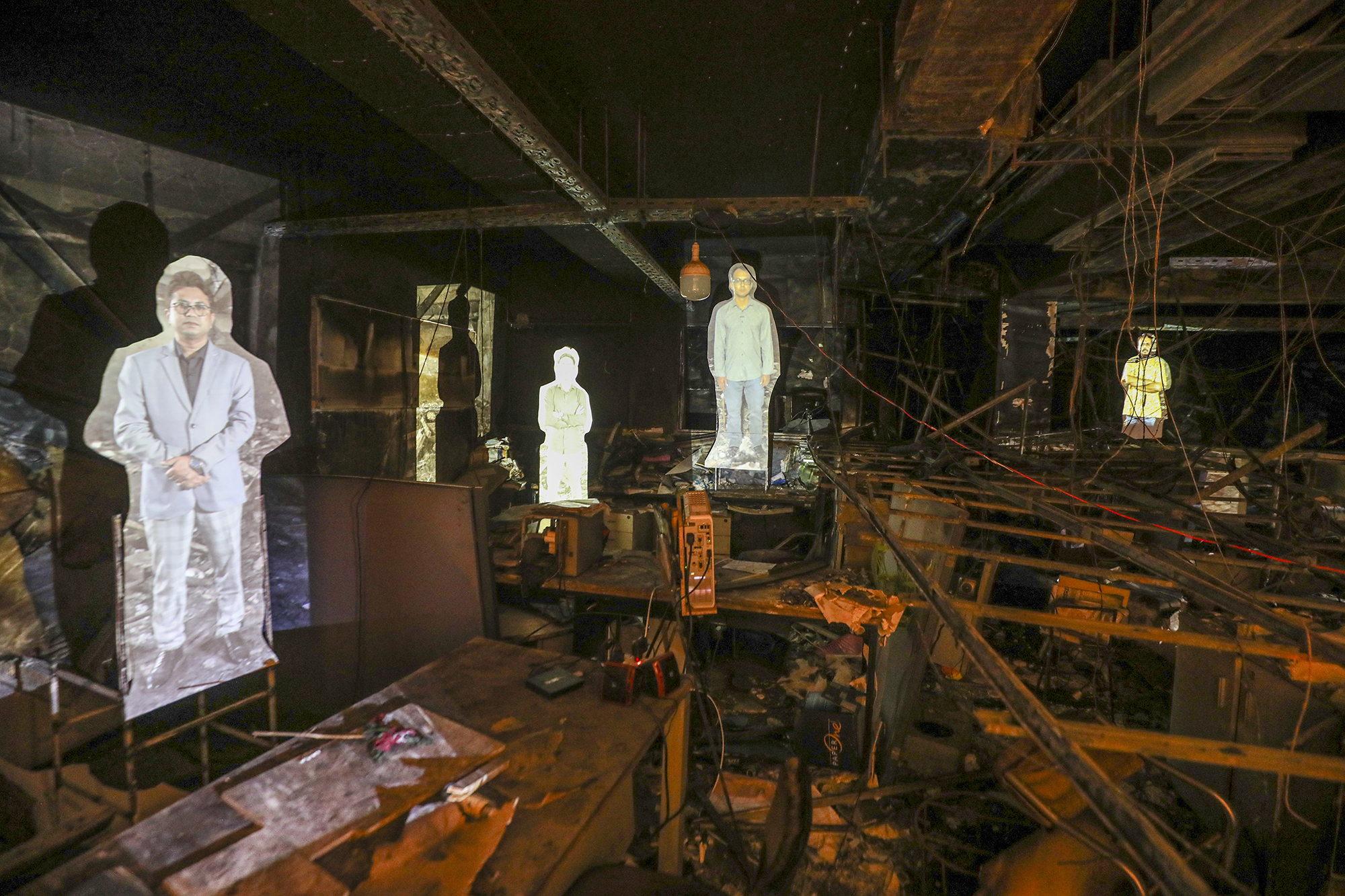
When the artist Mahbubur Rahman was first tasked to convert the site of the arson into a site-specific exhibition, to give it some kind of artistic shape and structure, he naturally found the task quite daunting. He surveyed the Prothom Alo building across all the five floors. He saw only darkness, layers and layers of black ash, each layer blacker than the one before, blacker than black, blacker than any black colour that he had seen before. He saw thousands of books burned and blackened beyond recognition with ghostly patches of white in the core. Charred papers and files lay scattered on the floors. He saw mangled and molten iron objects that he could not identify, he saw furniture, chairs and desks – burned, smashed and broken – strewn across the floors, false ceilings ripped apart, wires dangling from the roofs, tangled and black.
From this scorched interior landscape the artist had to carve a space of creative resilience; he had to create light and aesthetic order out of the abyss of black that confronted him. Mahbubur Rahman did not flinch.
This unique installation, something that I had never experienced before, covered all five floors of the building. Some of the inner walls were given a coat of brand new, crispy, white paint; others were painted yellow and in other muted colours, in contrast to the blackened books and other ashen remains that were exhibited.
In one room, two vertical columns of books, completely charred on the edges but startlingly white within, were encased in a sealed, transparent, rectangular, plexiglass box. In another, a large, iron cage with vertical and horizontal bars, displayed hundreds of smoke-damaged books neatly arranged to fit inside the cage. Alongside the cage, a neon light in Bangla brightly emblazoned, read, “Have a dip in this ocean and arise.” This simple but profound message was at the heart of this exhibition.
Rahman employed a range of media for the various installations across all the floors: wood, metal, glass, light, photograph, video, music, colours, moving objects, plants and pigeons. In one room a looping video on a large screen against one wall showed the mob of arsonists, burning, looting, smashing things inside, while Prothom Alo photographers filmed them from outside. One wall displayed multiple frames in pastel colours of objects twisted, mangled, broken and burned by the fire.
A few metallic human forms stood like silent sentries in one room, elusive but suggestive in its significance. In another darkened room, ghostly white forms moved silently along ropes strung just below the ceiling, while the room itself lay dark and untouched, a scene of near-apocalyptic stillness. A background score, plaintive but defiant, played continuously.
Different installations inspire hope in their own unique ways. In one, scattered amongst a pile of burnt and broken chairs and tables and other office fittings, there are visible signs of life: clusters of fresh, green indoor plants appear as signs of renewal. In another dark room, separated from spectators with floor-to-ceiling wire mesh, made even darker with the smoke-blackened objects, sudden flashes of light illuminated the faces of intrepid journalists who were perhaps trapped inside but miraculously escaped with their lives. A flock of pigeons fluttered inside, symbolically denoting both entrapment and peace at the same time.
To conclude, with another cliche: Prothom Alo (as well as The Daily Star) rose like phoenix-like from the ashes. Both newspapers resumed publication within a day of the arson attack. “Alo”, brilliantly conceived, curated, and executed by the artist, Mahbubur Rahman, transformed destruction into enlightening art. It will remain long in the memories of its viewers.
Shawkat Hussain is a retired professor of English, Dhaka University.