
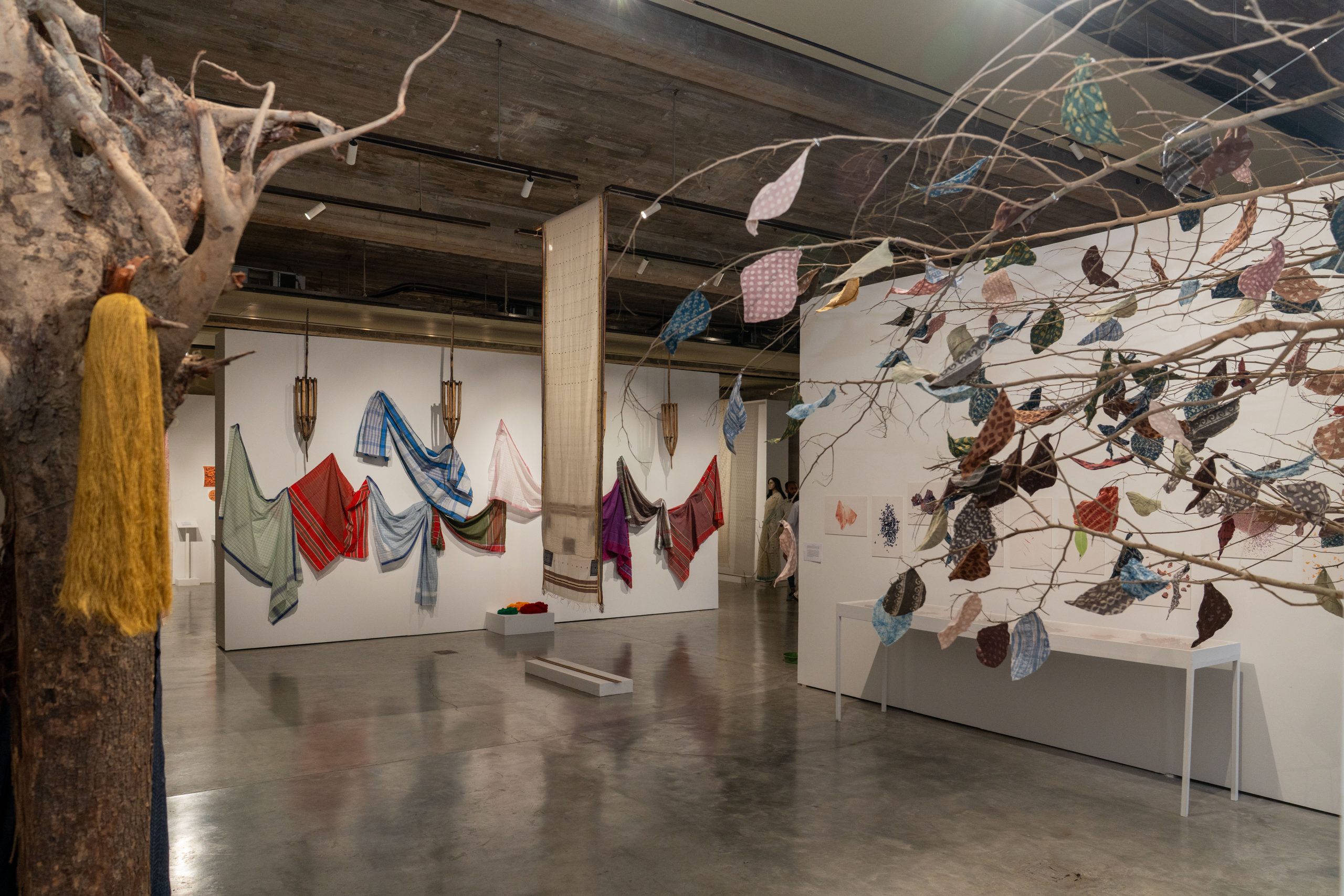
At Bengal Shilpalay last March, The Handloom Tradition of Bangladesh, an exhibition and fair invited visitors into the world of Bangladesh’s handloom weavers.
The first thing you notice is not the colours, but the hands. Deft, patient, moving in time with the soft, insistent thrum of the loom. The click and pull of wooden beams, the soft drag of thread, the patient repetition of hands trained by years of practice. The loom speaks in small mechanical syllables. In Bangladesh, that sound has echoed for centuries.
From March 8 to 16, 2026, the galleries of Bengal Shilpalay in the leafy neighbourhood of Dhanmondi transformed into a living archive of that sound. The exhibition and fair, The Handloom Tradition of Bangladesh, organised by the Bangladesh Handloom Board under the Ministry of Textiles and Jute and supported by the Bengal Foundation, invited visitors to consider something deceptively simple: cloth.
But cloth, here, is rarely just cloth.
The motto, “Wear the heritage, hearten the hands that wove it” runs like a thread through the exhibition, shaping its narrative from the outset. On the first floor of the Quamrul Hassan Exhibition Gallery, the story begins not with garments but with fibre. In the softly lit space, displays moved backwards through time. Finished sarees dissolve into skeins of yarn; the yarn into cotton; the cotton into the delicate story of a plant once famed across the world.
That plant is Phuti Karpas, the near-mythical cotton from which the legendary Dhakai Muslin was once spun. For centuries, muslin was said to be so fine it could pass through a ring. European traders marvelled at it; Mughal emperors coveted it. Yet the real wonder was not only the fibre itself but the extraordinary labour required to transform it into cloth. Spinning thread fine enough for muslin demanded the kind of concentration that turns work into meditation.
Here, the exhibition lingered on that process. Visitors encountered small demonstrations of hand-spinning, fragments of looms, bundles of raw cotton. The objects were modest. But they revealed the intimate choreography of handloom work – the subtle tension between fingers, thread, wood, and time. Each pattern, each motif, exists first in memory. A weaver often carries the design in the mind rather than on paper.
If the first floor invites reflection, upstairs, on the fourth floor the quiet contemplation of galleries gives way to a riot of hues, patterns, and the buzz of the fair.
Rows of stalls, fabrics cascading from walls, and the bright textures of regional weaving traditions gathered in a single place. Purposefully arranged, the fair connects makers and collectors, ensuring that the centuries of skill embedded in each weave are honoured where they belong – in the hands of the weavers. To the observant eye, the room unfolds like a map of the nation, its villages, rivers, and hills stitched into every weave.
There are the classics: luminous Jamdani sarees, their intricate motifs floating across fine cotton like suspended flowers, alongside rich Katan silks whose geometric precision reflects centuries of technical refinement. Elsewhere appear the regional fabrics that quietly sustain everyday life, such as the sturdy Cumilla Khadi cloths with their earthy textures; the soft familiarity of Tangail Saree; and the bright complexity of Manipuri weaving, with patterns that echo the cultural memory of northeastern communities.
Beyond clothing, there are household textiles, bedsheets woven in Kumarkhali and shimmering garments made from Rajshahi Silk. In another corner, attire from the Hill Districts introduces bold colours and graphic motifs that speak of indigenous design traditions often overlooked in mainstream fashion.
Events like this carry a certain political and economic urgency. Bangladesh’s handloom sector remains one of the largest cottage industries in the country, employing millions of people across rural regions. Yet it exists in a precarious balance. Mass-produced factory garments which are faster, cheaper, endlessly replicable, dominate both global markets and local wardrobes.
Handloom work moves at a different pace. A saree may take days, even weeks. The loom cannot be hurried.
The exhibition was inaugurated by Khandaker Abdul Muktadir, the Minister of Textiles and Jute, who underscored both the economic and cultural value of the sector, pointing to its role in rural employment and noting that several traditional textiles, including muslin, Jamdani, and Tangail sarees have already received GI recognition, with more underway. Yet policy alone cannot preserve a craft. What is really at stake is something less measurable: inherited knowledge.
A master weaver may know dozens of patterns without written diagrams. The fingers recognise the right tension in a thread; the body remembers when to pause, when to pull, when to shift colour. These gestures are transmitted across generations, through apprentice beside parent, child beside loom.
Lose the practice, and the knowledge dissolves with it.
The exhibition’s curator, Shawon Akand, describes the initiative as a meeting ground for researchers, artists, policymakers, and ordinary visitors. The hope is that curiosity might translate into appreciation, and appreciation into patronage.
In an era dominated by what the fashion industry calls “fast fashion,” the handloom offers slow textiles as another possibility. Garments that carry visible labour within them. Fabric that bears the quiet irregularities of human hands.
Walking through the fair late in the evening, one notices again the sound of weaving demonstrations in a small corner of the room. The loom continues its patient rhythm.
It is easy to think of heritage as something distant, preserved behind glass. Yet here it remains alive; held in motion, in work, in thread passing through calloused fingers. To visit the exhibition is, in the end, a simple act. One wanders through rooms, touches cloth, perhaps buys a saree. But it is also an act of recognition. Because somewhere far from the gallery lights, in villages scattered across Bangladesh, the looms are still speaking. And each measured click carries forward the fragile, resilient memory of a craft that has never entirely fallen silent.