
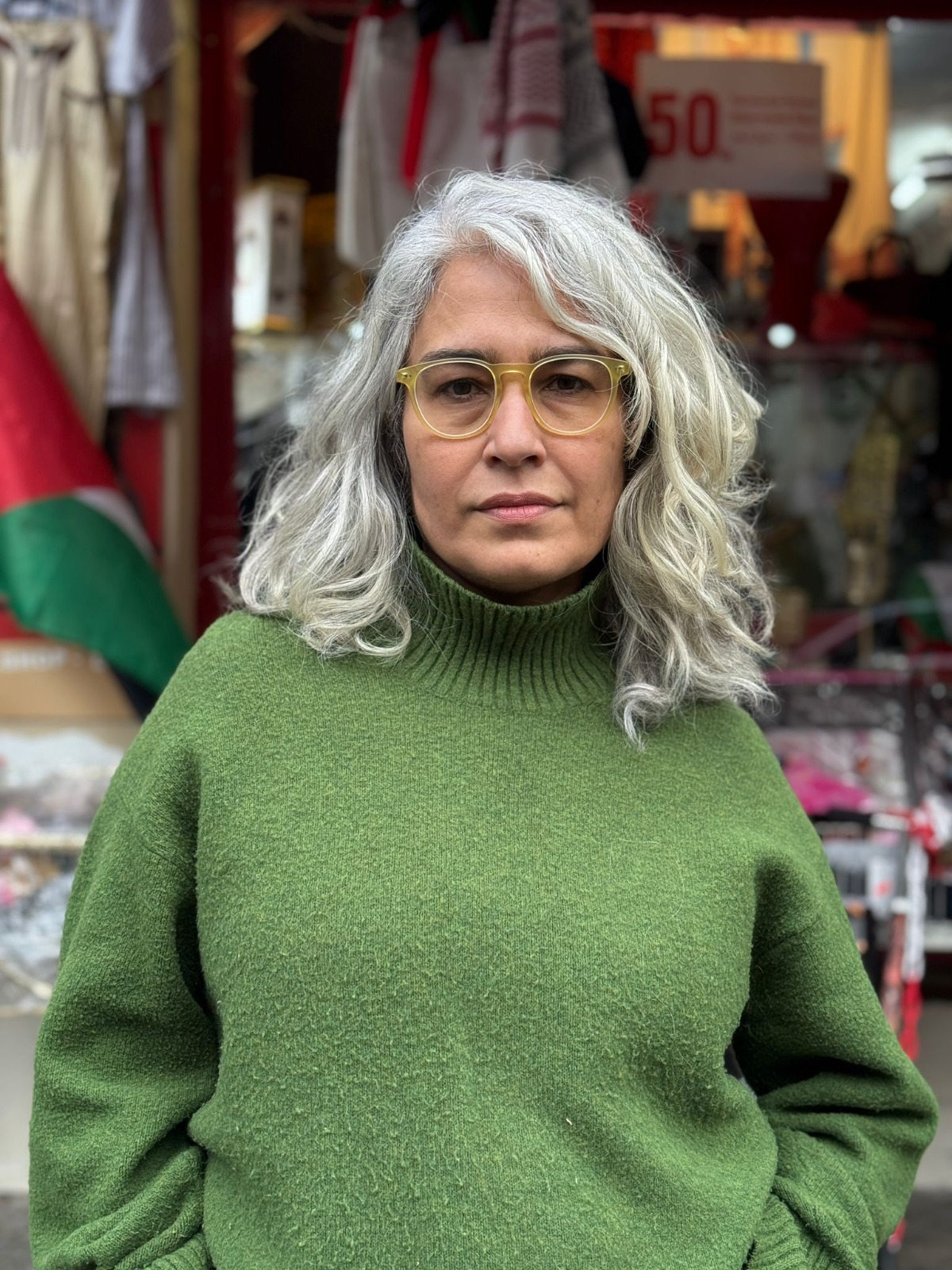
Critics often call Bani Abidi’s work a South Asian version of Waiting for Godot – it’s existential, it’s Beckettian, and it usually involves a lot of waiting. We are often told that these contrived national and religious stories are what define us, yet Abidi’s lens tends to drift elsewhere, like the sterile wait of a visa office, the placement of a security barrier, or a particularly bureaucratic bowl of mangoes. She is a master of the periphery; while history books focus on the people making the speeches, Bani is watching the person adjusting the microphone or the crowd stuck behind a police barricade. Her work is a witty, sometimes heartbreaking reminder that the most normal parts of our lives – the way we wait, the way we laugh, and the way we survive – are actually our most profound acts of defiance.
She arrived in Dhaka this January for Chobi Mela XI, appearing amidst the lingering, electric hum of the 2024 Uprising. Between her workshop and the exhibition at the Alliance Française de Dhaka, her schedule was predictably packed, but we managed to catch her for a brief, lovely conversation amidst the chaos.
You arrived in Dhaka during a period of immense transformation following the 2024 Uprising. As someone who maps the theatre of power, how does the energy on the streets of Dhaka right now compare to the bureaucratic stiffness you often satirise in your work?
Dhaka, and the political moment it is currently in, both experiences have been unique for me. For a Pakistani to experience a moment of political expression and a revolutionary spirit in Bangladesh is that much more intense, as one tends to project it onto what we have heard about the protests and the movement that led to the liberation of Bangladesh in 1971. It’s a bit awe inspiring. So it feels like a real life rendering of what I have only heard about. There is a slogan I saw painted in a few places here, that said “If you want a revolution, call Gen Z,” and that encapsulates the spirit really well. The uprising feels like it was partially location specific and partially generational. I feel that this moment of anarchy is very interesting and something that is increasingly going to spread across the globe, the youth does not feel that they have to find the solutions, they just have to point to the problems. What is being sought is a new world and they are playing their role in demanding it. As an artist I am obviously not content with dominant narratives and a status quo either, so change is much more promising, even if it means going through chaos and uncertainty. Bureaucratic stiffness is a laughable matter, and will be incorporated into all forms of governance and control, new ones too. I don’t see us being liberated from those any time soon.
In many of your pieces, the hero is an anonymous extra or a silent bystander. Is your work an attempt to reclaim a history that usually ignores the common person?
Yes, maybe it’s a way to extricate ourselves from the narratives of being “nationals” of this or that country, or the assumption that we collectively belong to this or that religion and abide by it in uniform ways. The meta-stories of the State are so contrived and oppressive, and obviously so unreal that they can only come into effect by being shoved down our throats in school or the mosque. Obviously, regular people for the most part are much smarter and complex than a bunch of uncles sitting and deciding how they should live and think. I like to imagine regular people and see their vulnerability, love, solidarity, biases, defects, compulsion, confusions, and observe how they negotiate daily life and these ideologies.
Your work often makes people laugh before they realise the tragedy of the situation. Is humour a tool for survival, or is it a weapon to disarm the viewer? How do you balance that satire with the deep sense of longing we feel in your films?
Satire is probably easier to create, whereas melancholia is not something one can script, it’s the effect of a work. I use satire to bring down positions of control and power, to demolish a character’s or a group of people’s sense of self aggrandisement, with simple gestures. Satire is never directed at the people around me, us who are trapped in situations where we have to contend with those in power. Ours are more of those studies of tolerance, humor and survival that create a sense of melancholia because they are open ended moments, not clearly indicating where we are headed.
In my film RESERVED, a city has come to a standstill because a State guest is driving through the city in an escorted security motorcade. The emphasis is obviously not on the character of the “VIP,” but on the people of the city who are waiting for him to pass by. It’s a frustrating situation and people act in all sorts of ways, and just like we would in real life, you smile at the way people use this time of waiting. So it’s interesting to think what kind of amusement my work generates, it’s rarely of the guffawing laughter variety.
This year’s festival theme was “Re.” In your view, what is the most important thing for South Asian artists to re-imagine or re-learn about our shared histories today?
I think everyone needs to question everything that their school teachers or parents taught them. We all come from very hierarchical societies, and it’s astounding how narratives about gender conformity, love, sex, careers, success, reproduction etc are hammered into us as “normal.” I don’t need to even say this, the younger generation is quite good at questioning these assumptions that are imposed on them.
Also I think that we as South Asian’s even after questioning “normal” structures of family and economy, we still can find ways to maintain inter-generational community and love and co-existence. It’s a gentler and sharper negotiation than what I would find in liberal attitudes in the West.