
Rickshaw Art Festival 2026, exhibits stories, heritage and the uncertainty of Artists
Advertising, storytelling, and an understanding of Bangladesh’s social values and cultural norms are most vividly expressed through rickshaw art, especially in Dhaka – widely known as the city of rickshaws. They not only transport passengers but also carry vibrant stories and moral messages from one place to another, serving as moving canvases of expression. In recognition of this rich cultural expression, Shei Dhaka partnered with Awake Cafe Roasters and the North South University Art and Photography Club to host the Rickshaw Art Festival 2026, an event comprising exhibitions, panel discussions, and workshops celebrating storytelling, heritage, and artistic vibrancy.
The festival officially commenced on January 28 at 11:00 a.m.; however, anticipation had already been building with a preview installation featuring a rickshaw displayed as the central structure at North South University’s Lower Plaza. The inauguration ceremony was attended by photojournalist Shahidul Alam, Cultural Affairs Adviser Mostofa Sarwar Farooki, a representative from the Embassy of Kosovo, and Dr. Abdul Hannan Chowdhury, Vice-Chancellor of North South University.
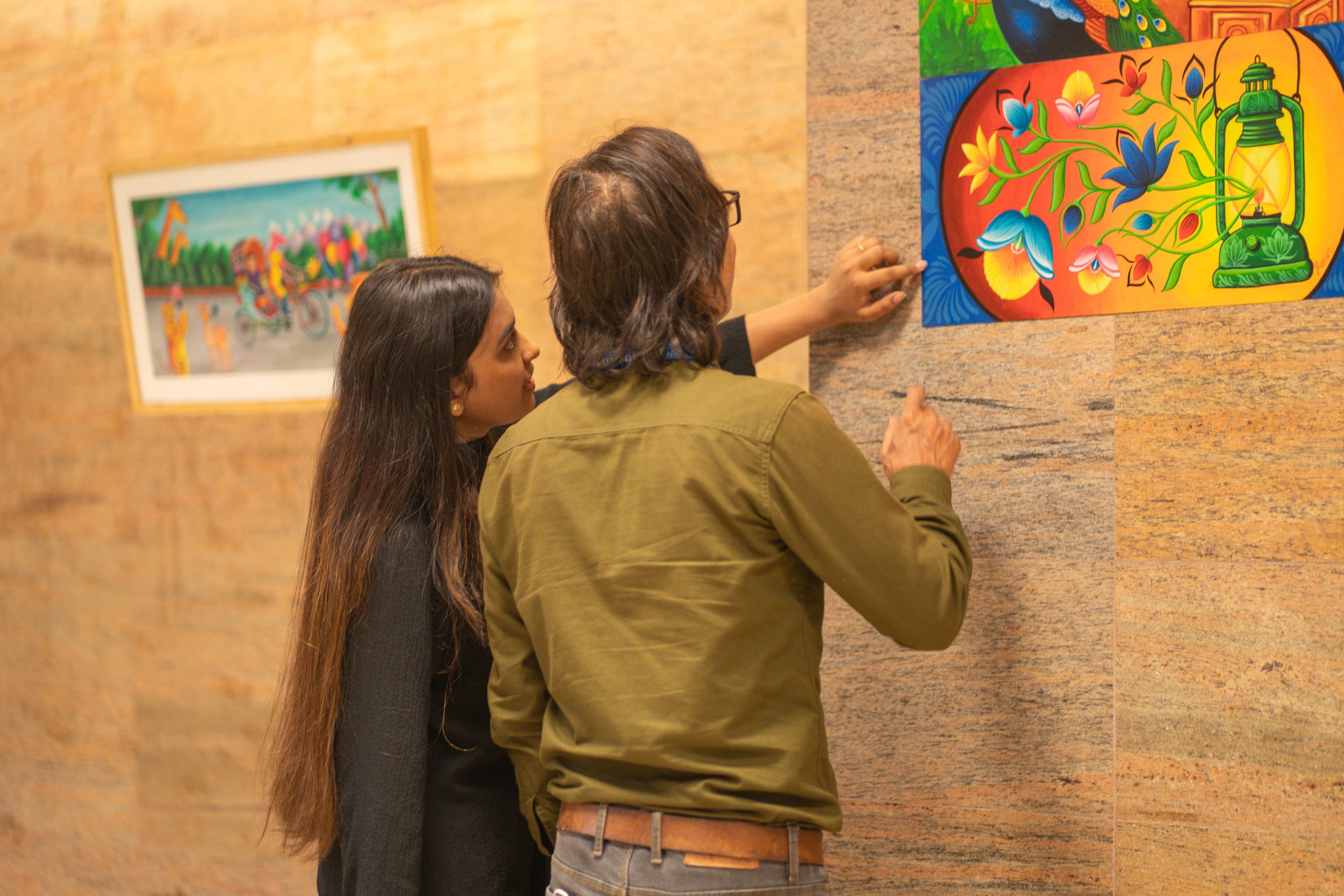
The exhibition brought together five prominent rickshaw artists: Mohammad Hanif Pappu, Dilip Kumar, Syed Ahmad Hossain, Rafiqul Islam, and Monir Hossain (Monir). The entrance was designed to resemble a traditional rickshaw hood, with fragments and motifs of rickshaws thoughtfully integrated throughout the space. Along the left wall, the artists’ nicknames were painted inside comic-style speech bubbles, rendered in a traditional Bengali rickshaw font. Upon entering, visitors were immersed in a vivid palette of red, green, blue, and yellow in their fullest vibrancy, splashed not only across paper and canvas but also on everyday objects such as cups, steelware, boxes, jars, kettles, hurricane lamps, and trays. Traditional Bengali motifs – including lotus flowers, tulips, leaves, and peacocks – adorned the works. Alongside these were imaginative, fairytale-like scenes: tigers pulling rickshaws or playing cards at a table, folkloric depictions of tigers and herons, a deer cast as a rickshaw puller with a monkey passenger, and even a lion selling balloons, each artwork unfolding its own whimsical narrative.
Several artworks conveyed powerful social messages. One depicted lifeless birds, highlighting the harmful effects of fireworks and lantern releases on New Year’s Eve; others called for an end to war and genocide, warned against deforestation, and addressed pressing social and political concerns. These themes echoed the very essence of rickshaw art – a moving canvas that carries messages through the streets.
The exhibition also featured posters of classic Bengali films such as Bhondo, Khairun Sundari, Tumi Amar, and Bhoyonkor Bishu. Particularly striking were reinterpretations of popular Western sitcoms and fictional characters rendered in the rickshaw art style. Posters inspired by The Office, Breaking Bad, and Stranger Things appeared alongside vibrant portrayals of characters such as Mr. Bean, Captain Jack Sparrow, and Harry Potter. This fusion of Hollywood pop culture with indigenous rickshaw aesthetics resonated strongly with Gen-Z audiences, adding another layer of contemporary relevance to the exhibition.
Given the long-standing relationship between rickshaw art and cinema, three award-winning Bengali films – Aynabaji, Monpura, and Rickshaw Girl – were screened at the main auditorium of North South University, further enriching the festival’s celebration of visual storytelling.
Later that day, One Culture hosted a hands-on rickshaw art workshop at the Upper Plaza from 11:00 a.m. to 2:00 p.m., led by distinguished guest Sunil Kumar. The session introduced students to the techniques and traditions of rickshaw art, welcoming participants from both university and school levels. The following day, an art competition was organised at the same venue and time, with all necessary materials provided by the organisers.
On 31 January, a panel discussion titled “How Can We Preserve & Promote Rickshaw & Cinema Art Globally? A Heritage at Risk of Fading” brought together prominent cultural leaders and policymakers. The panel featured Rezauddin Stalin, Director General of Bangladesh Shilpakala Academy; Dr. Abdul Hannan Chowdhury, Vice-Chancellor of North South University; Luva Nahid Chowdhury, Director General of Bengal Foundation; Redoan Rony, Advisor of SheiDhaka and CEO of Chorki; Susan Vize, Head of Office at UNESCO Bangladesh; and Sumaina Abedin, President of One Culture Foundation. The discussion shed light on critical challenges surrounding the preservation, global promotion, and sustainability of rickshaw and cinema art, emphasising the urgency of safeguarding this fading cultural heritage
Despite rickshaw art’s recognition by UNESCO as an element of intangible cultural heritage, pressing concerns remain about the precarious livelihoods of rickshaw artists. Panellists questioned why many practitioners continue to live in financial hardship and highlighted the risk of the tradition fading as younger generations hesitate to pursue the craft due to inadequate income. The discussion also examined how the rise of digital prints and inexpensive vinyl reproductions threatens the authenticity and economic sustainability of hand-painted works. Concerns were raised about whether the heritage status could retain its significance if the practice itself diminishes, especially amid a growing trend toward increasingly simplified designs – sometimes reduced to little more than a rickshaw puller’s number and phone contact on the back panel.
To address these challenges, several solutions were proposed, including systematic research, archiving initiatives, educational programs, and policy reforms aimed at improving artists’ livelihoods. In recognition of their contributions, twelve rickshaw artists were honoured on stage with commemorative crests. As a roaming exhibition that travels to every corner of the country, rickshaw art remains a living cultural expression – and this initiative by the Shei Dhaka stood as a meaningful effort to keep that movement alive.