
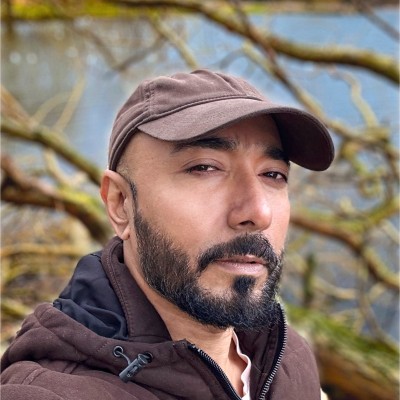
Goutom Saha’s fashioned Bangladesh
Bangladeshi fashion is loud, colourful, and impossible to ignore, much like a neon saree at a black-tie gala. But the real magic is quieter, subtler, and lives in the thoughtful gestures of Goutom Saha, who proves that influence doesn’t always need a runway to make a statement. As the long-term Fashion Editor for ICE Today, Saha is a man whose reputation precedes him; he is whispered to wield a Miranda Priestly-esque level of reverence within the industry, yet those who work with him speak of a mentorship that is nurturing rather than cutthroat.
We meet not over a coffee, but in the brief, focused calm of a working day. Having only been at ICE Today for a year, my own experience with Goutom Saha was entirely secondhand before this interview – composed of sparse WhatsApp messages, the reverent tales of colleagues who spoke of him with a mixture of admiration and affection, and the magical way doors opened across the industry once I mentioned my affiliation. Yet, when I left those meetings, the question was never about me, but always “how is Goutom?” This conversation was my first chance to look behind that reputation and see the meticulous, image-conscious fashion editor at work.
Long before he became synonymous with fashion at ICE Today, Goutom Saha was part of the machinery that built it. A year before the magazine debuted, he joined the company as an administrator, a role that placed him behind the scenes at a time when the very concept of a glossy lifestyle publication was still unfamiliar territory in Bangladesh.
This was the early 2000s. The country’s retail and fashion industries were growing, but the language of branding, of curated imagery, of aspirational print, had yet to fully take hold. Many of the businesses the magazine hoped to attract as advertisers had never seen what a full-page spread could do for them. So Saha and a colleague took the magazine directly to them. Issue in hand, they went from shop to shop, laying it open on counters, explaining what an advertisement would look like, how a brand could occupy space on the page, why visibility in print mattered.
In hindsight, there is a pleasing irony in the image: the future fashion editor conducting what were essentially masterclasses in visual literacy long before he claimed that title. It was patient, methodical work. Part sales, part education. The polish that now defines ICE Today was built on these standards and relationships.
Goutom Saha’s move into fashion was less a calculated pivot and more a well-timed shove. A chance encounter placed a campaign in his hands, and suddenly the administrator was running the room. There was no announcement, no rebrand, just a deadline and the expectation that he would deliver. He did. In delivering it, Saha recognised an instinct for image, narrative, and coordination that felt both surprising and inevitable.
Since 2003, he’s been part of every page, every campaign, every fashion editorial. Today, the story of ICE Today is inseparable from his. It is here, at this intersection of reputation and craft, that we meet him to understand the mind and method behind Bangladesh’s most influential fashion editor.
You are widely celebrated for having the most discerning artistic eye in the industry. How does one’s brain develop into a master’s eye?
Developing this perspective comes from a deep, continuous hunger to learn and observe. When I go to work, I treat the first few hours of each project as the first ever work of my life. I don’t know if it will work or not. It involves studying the full photograph and understanding how to analyse photography thoroughly, not just seeing it. Practically, it requires asking questions constantly – why something is good, why it isn’t, and what needs to be done to improve it.
I believe an artist’s dissatisfaction with their own work is the only thing that can truly move them forward. Satisfaction is merely a dead end. Furthermore, it is important to be critical of oneself to neutrally observe whether the work is actually reaching the required level. I think a lot of ego also works here – not with others, but with oneself – to ensure every day I do a little better than the previous work.
Over the decades, your covers or campaign shoots have often acted as cultural barometers in Bangladesh, frequently going viral. When you look back at that exhaustive archive, which specific project do you feel truly reset the industry’s internal clock?
While several projects remain memorable, the cover photoshoot I did with Dilara Zaman for March 2019 issue really stands out as a landmark moment. It was a massive success that reset the trend by celebrating a persona in a different perspective, rather than just airbrushing her skin or giving her a makeover. We presented her age vibrantly and fashionably, which was a first for the industry, resulting in thousands of shares. The May 2022 cover with Jaya Ahsan wearing Preyali, along with the Jarwa House cover featuring Badhon for the August–September 2021 issue, also remain particularly meaningful.
As someone who has watched this industry grow from its infancy, what is your honest assessment of where Bangladeshi fashion stands today, and what is it missing?
Honestly, I don’t really see fashion in Bangladesh as it is now; All I see is retail. In terms of fashion, we really need to work on our understanding.
While material, production, and design are available, those who produce fashionable clothes or work in boutiques struggle a lot to survive. We need big investors to enter, and the market needs a lot of logistic support to survive in a place like Bangladesh. If the government is involved in making materials available, then the fashion industry will get a lot of support at the mass level. We also have to improve our fashion designer institutes. We have a cultural connection with India and Pakistan, but we are not of the same caliber yet in terms of production or quality. We have a lot to grow in that area, and we have to put in a lot of effort.
Finally, for the next generation of fashion editors who are coming up in an era where the internet makes everything look easy – what is the one piece of advice they actually need to hear?
For the new generation, there is no such thing as a mentor or advisor anymore because of the internet – everything is so open in the world. I am sure they understand a lot of things.
But at the end of the day, professional commitment, dedication, and ethics matter a lot. It is important to be mindful of how easily personal preferences can influence professional decisions. You may like someone, but that does not always mean they are the right fit for the work; equally, someone you may not connect with personally might still bring exceptional talent to the table. Being able to separate personal feelings from professional judgment, and putting the work first is essential.
The hunger to do good work, to do better, is what keeps you going. An artist cannot be satisfied, and an artist’s dissatisfaction with their work is the only thing that can take them forward.
You have to keep learning; it is continuous. And lastly, teamwork matters a lot. I have received more than 100% support from my team and colleagues including designers, makeup artists, photographers, and lighting designers. At the end of the day, all the accolades in the world matter very little; a person can never be bigger than the work.