
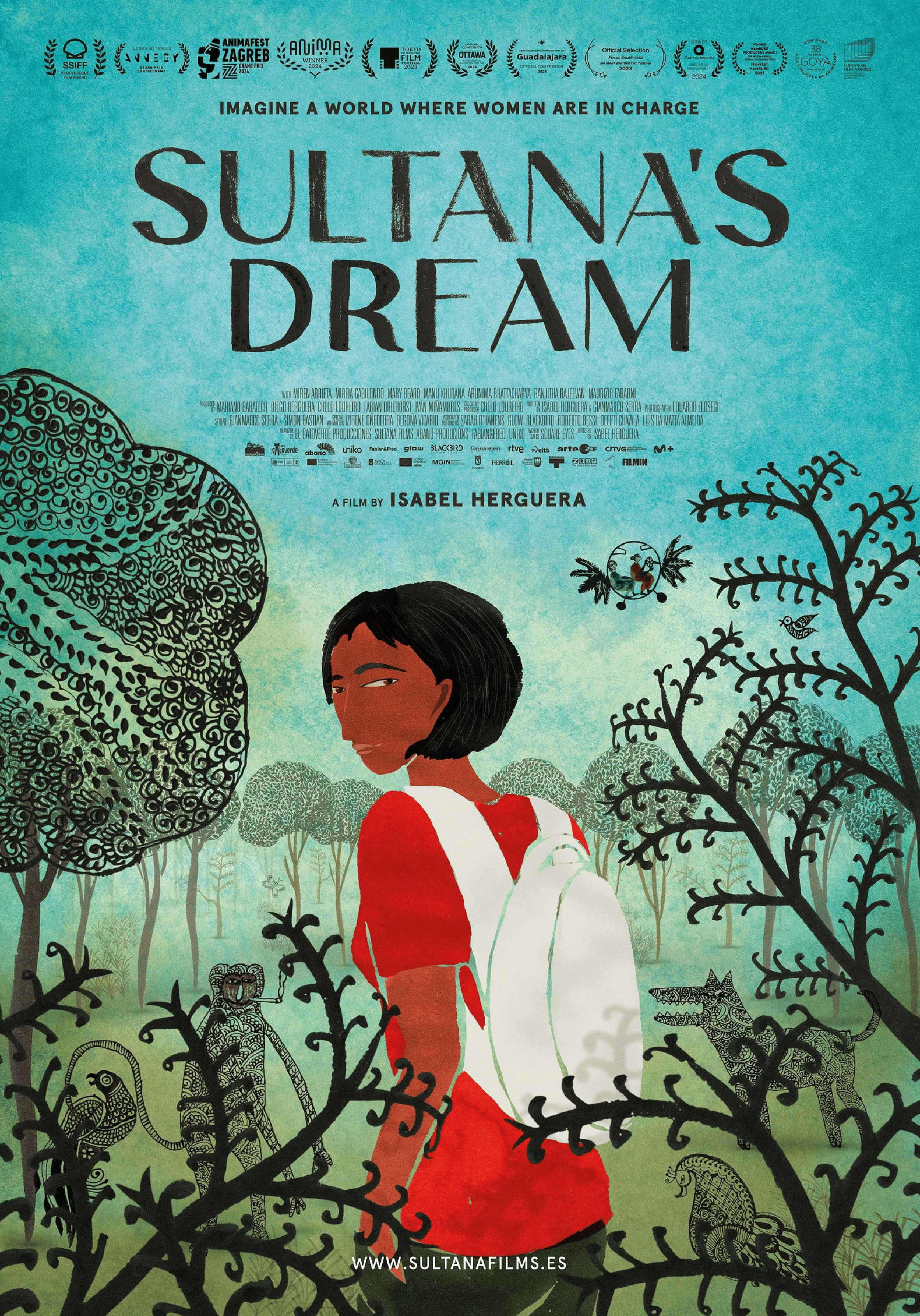
The recent Bangladesh premiere of the Sultana’s Dream animation by Isabel Herguera is a surprising interpretation. Not so much a retelling rather than a poetic musing on the position of women in the universe of dreams. The animation is gorgeously crafted, combining several artistic styles and merging personal narrative with Rokeya’s biography and Sultana’s Dream. It evokes Jungian active imagination–a free-flow between consciousness and unconsciousness to synthesize a deeper understanding of what it means to be a dreaming woman, a dreaming human.
The animation is gorgeously crafted, combining several artistic styles and merging personal narrative with Rokeya’s biography and Sultana’s Dream.
Risana Malik, a fellow reader and viewer, reflecting on the animation wrote “Isabel Herguera’s Sultana’s Dream takes you into the fragmented realm of imagination itself; one negotiating with a patriarchal present.” When Sultana had her radical nap in 1905, she triggered the dream by thinking (lazily) of the condition of Indian womanhood. In her easy chair, she slipped into the dreamscape of Ladyland, and discovered a hopeful alternative to her limiting reality. Since, the dream has been analysed, quoted, referenced and reinterpreted. It has inspired many academics, feminists and futurists to propose alternative social structures. The short story packs a lot – containing technological, political, economical, social and even urban planning insights. It is an invitation to dream–and this is the thread that Herguera follows.
The animation is closer in nature to a poem than a story. An abridged version of Sultana’s Dream is woven into the larger story of the protagonist as she goes on her hero’s journey of discovery. Rendered in the style of henna drawings to symbolise transience, womanhood, ritual, this part of the animation is familiar to readers of Rokeya. But moving onwards, the animation transcends the social and political nature of the original tale and dives into a world of ornate symbols – white monkeys, widows, whimsical artists–archetypes that invite deeper reading.
“The film, to me, was not a simple or fulfilling watch. It bothered me with the tired familiarity of how the protagonist’s story so often traced back to the validation of male parental or romantic figures. It saddened me that this was how I learned that Begum Rokeya, was not allowed to be buried in a Muslim graveyard, for the sin of luring girls out of their homes towards education. I was also conflicted between appreciating an outsider’s perspective of stories and art of my homeland in ways that those of us living in it might not, and cringing at the occasional lean towards being the exotic backdrop of their self-discovery journey (though the widows in Vrindavan do their bit to challenge that in the film). At the end, it felt like a step back from the inventions and political acumen of Begum Rokeya’s characters,” reflected Risana.
Throughout the film, the driving crisis is that the protagonist is struggling to dream. Her obsession with Rokeya Sakhawat Hossain leads her to visit Rangpur and Kolkata. She is haunted by visions of the modest headmistress, a sensual dancer and a sting of widows – each representing aspects of the feminine experience. She falls in love with an artist and has a brief love affair with a female travel companion – these affairs are transient, the sensuality of the encounters is free of promise of commitment.
“However, I am glad for the discomfort,” Risana delves deeper. “While there was no Ladyland at the end of the tale for either the protagonist or the viewer, Sultana’s Dream reminds you that inspiration and imagination aren’t meant to look the same for us all. The questions you have at the end of the movie take you back to the original story, which, at its core, is also one person’s self-discovery journey in an exotic land. When we step out of that dreamscape, itching for a more evolved future, what do we write and build to get closer to it?”
Herguera suggests that the act of dreaming – of being able to imagine beyond the known and tapping into an unconscious where polar opposites exist in harmony – this is fundamental to creating a different world.
Herguera suggests that the act of dreaming – of being able to imagine beyond the known and tapping into an unconscious where polar opposites exist in harmony – this is fundamental to creating a different world. There is an underlying grief throughout the film, a note of sadness and loneliness that is not hers alone – it is the inheritance of women throughout time. The animation is full of skin. Blue, green, dark, all shades but white. Here skin is a sensory metaphor – a vehicle for life, which we transcend to dream freely. How do we dream freely?
In 2026, 121 years since the original publication, HerStory Foundation, with the support of the British Council Arts Programme and the WOW Foundation, will be producing an original theatrical interpretation of Sultana’s Dream. The production will employ forum theatre participatory techniques to invite audience members to imagine alternatives together with the actors. Future thinking is no easy task, the present is imposing and demanding, but with enough cheering, enough whimsy, enough license – we can dream.