
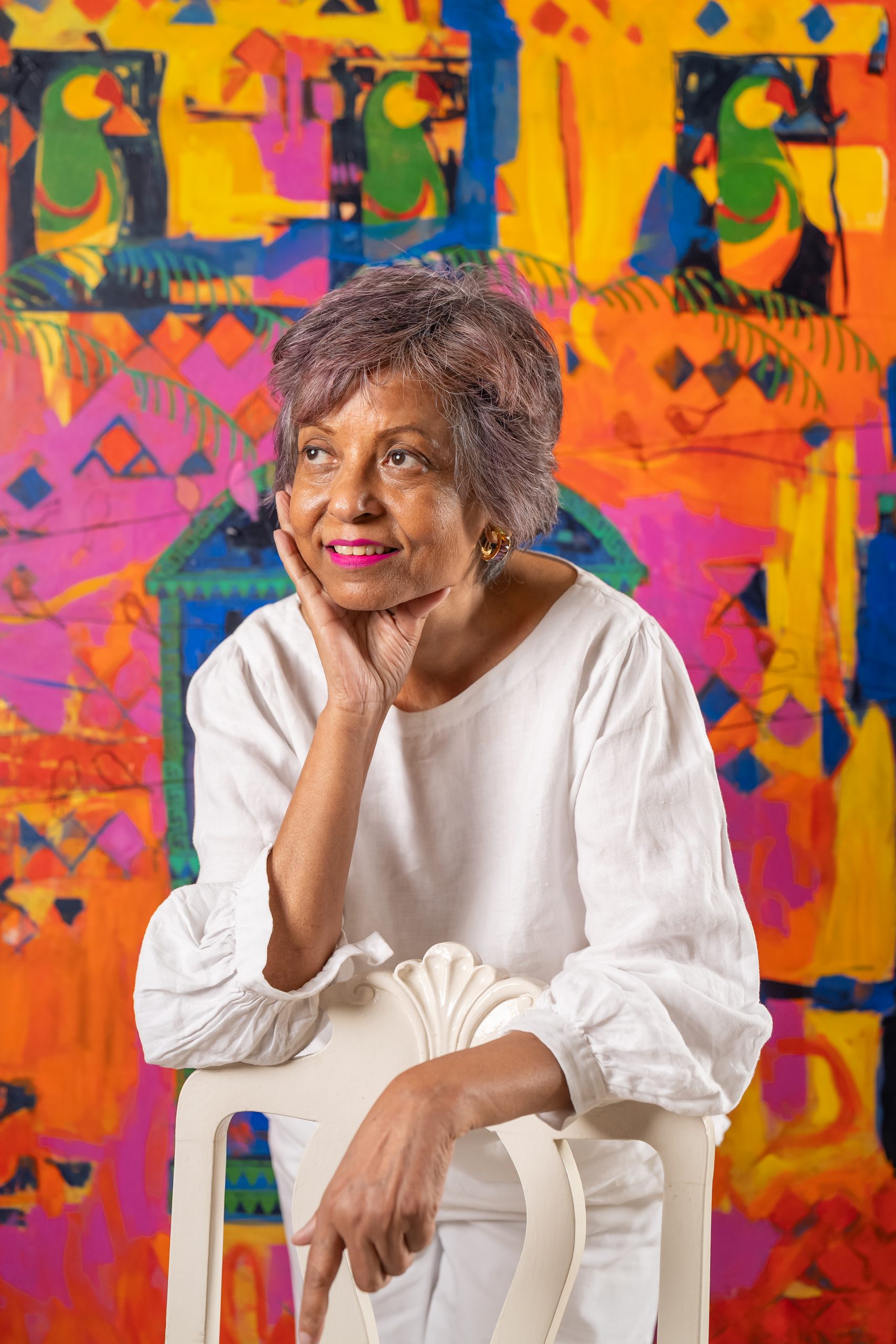
In conversation with Kuhu Plamondon, the artist who turned the six-yards saree into a canvas for the city’s chaos and beauty.
Artist Kuhu Plamondon has never believed in keeping still. Just like the city, where colour, texture, and movement are part of the everyday, she has long blurred the lines between art and life. For her, a canvas is not confined to gallery walls. It spills into the streets, wrapped around bodies, stitched into fabric, and carried through the rhythms of the city. Working across mediums from painting to textiles, Plamondon approaches creation with a restless curiosity, drawing on the lived realities around her, from the spontaneity of street style to the resilience of working people and the layered visual language of Bangladesh itself.
Her practice is rooted in transformation of materials, narratives, and perception. Scraps become statements, the everyday becomes aesthetic, and the local finds a way to speak universally. At a time when conversations around identity, sustainability, and representation continue to evolve, Plamondon’s work feels both grounded and forward-looking, shaped by decades of experience yet energised by an enduring sense of play. In this conversation, Kuhu Plamondon reflects on movement and material, the evolution of artistic voice in Bangladesh, and why, for her, art is always meant to be lived with, not just looked at.
You’ve famously described the saree as a six-yard canvas. For you, what is the fundamental difference between someone viewing a painting on a gallery wall versus someone wearing that same art through the streets of Dhaka?
I don’t think preference really works like that for me. I get bored very easily – I am a dream maker. So I move between things. I work on canvas, and after a few hours, when I get bored, I shift to a saree or my sketchbook. Even in a café, I am always scribbling or drawing.
Two people can wear the same saree and produce entirely different forms. Tradition, then, is not fixed but constantly in motion.
The difference is in the material and also in the human body. A body moves, it carries the work through the city. That movement changes everything.
Do you find functionality, like the utility of a bag or garment for example, restricts your creative expression, or enhances it?
It enhances it, definitely. For me, art has to be functional. We can hang paintings on walls, yes, but I like things that are used. I have worked a lot with recycled materials, scraps of cloth, old table mats, even sweaters cut up and reassembled. Nothing matches, but that’s the point. Everything gets a second life.
Recycle, reinvent, reuse – that’s my process.
Do you find yourself drawn more to lived-in materials and lived-in environments, and what is it about those that fuels your work?
I like to be among people. That’s where I feel most inspired. I have never really been interested in landscapes on their own. For me, it’s always about people – what they’re wearing, how they’re living, the small details of their everyday lives. I observe all of that closely and think about what I can take from it and transform into something new.
Dhaka inspires me constantly. There is so much happening all the time, visually and emotionally. Even RMG workers, for example. You see them dressed in the most unexpected ways, sometimes mismatched, but there is a kind of beauty in that. I try to find that messy beauty and turn it into something you can carry into your everyday life.
How has the artistic voice of Bangladesh changed since you were a student of the Fine Arts?
In those early days, things were more structured, almost like being told, “this is what you will do.” There were clearer boundaries, and we followed them. We weren’t very bold then, maybe because everything was still so new and uncertain.
After independence, there was a strong sense of urgency. We were all pushing forward, trying to build something, to define what our artistic identity could be. The pioneers played a huge role in shaping that foundation, and naturally, we looked to them for direction. It was a time of formation more than experimentation.
Now it feels very different. Today’s generation knows how to be bold. They are more confident in their choices and much more open in how they express themselves. There’s less hesitation, less fear of stepping outside convention. It feels freer, more fluid, and more self-assured. And, that openness is something I really appreciate.
Over the years, how has your portrayal of women evolved?
Earlier, maybe there was a sense of incompleteness. Women didn’t always have a voice, or at least not a full one. Over time, that has changed for me. The women I paint now have voices, they feel more present, more self-assured, more whole. But even then, I have never been interested in showing women only through pain or suffering. Many artists focus on oppression, and while that reality exists, I don’t want to limit women to that narrative alone.
I prefer to show strength, especially the figure of the mother. To me, the mother is the strongest presence, someone who carries resilience and care all at once. Sometimes I paint women with many arms, almost like a force of nature, to express that sense of multiplicity and capability. There is a kind of power in them that I want to bring forward.
You’ve worked on projects like your collaboration with BGMEA and collections inspired by the Sundarbans. What was the thought process behind that work?
It came from thinking about what Bangladesh actually is in a global sense.
We are often overwhelmed by Bollywood or Pakistani fashion influences. So I wanted to ask, what can we export from our own culture?
I have always been inspired by the Sundarbans, by mosques, by our architecture, rivers, plants – everything. Even traffic in Dhaka. I made a scarf inspired by Dhaka’s traffic, with tempo motifs.
The idea is to make something local feel universal. If I just show a river from Bangladesh, someone abroad may not understand it, but if it becomes a design language, then it travels.
For younger artists, what is the one piece of advice you would give them?
You have to work hard and stay grounded in your culture. You cannot be a copycat, especially in fashion and design. You should aspire to be extraordinary in your own way.