
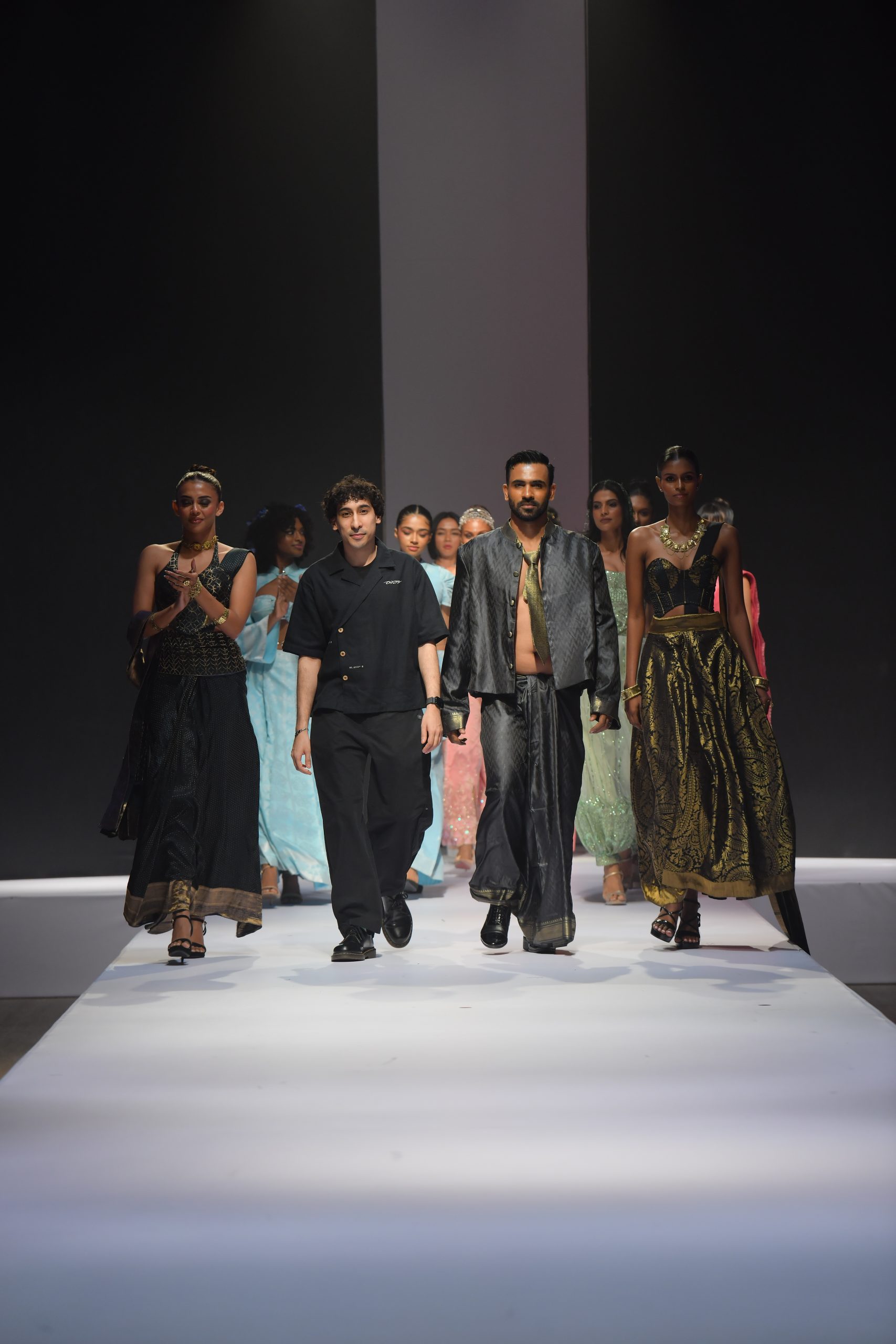
As Bangladeshi fashion continues to find its footing on international runways, Asad Sattar is positioning his label Ami Dhaka as both a cultural archive and a forward-looking design studio. At the 23rd edition of Colombo Fashion Week, Asad presented a collection that reframed the saree – not as a static emblem of tradition, but as a dynamic system of design, structure, and storytelling.
At the core of the collection lies a deliberate material language. Drawing from katan, benarosi, jamdani, and sequined textiles, Asad constructs garments that move fluidly between memory and modernity. Through layering, draping, and reassembly, the saree is deconstructed and rebuilt into silhouettes that resist fixed categorisation. The result is a body of work that treats textile as both medium and message.
Colour plays a narrative role. The collection unfolds as a life cycle — blue marking birth, green representing growth, pink signalling bloom, followed by nectar tones, and ultimately black as closure. This progression is not heavy-handed, rather, it operates as an underlying rhythm, guiding the viewer through an emotional and conceptual journey. In doing so, the garments become less about individual looks and more about a continuous story; one that mirrors cycles of existence while remaining grounded in the tactile reality of fabric.
Asad Sattar frames this approach within the idea of heritage futurism, a term that has gained traction in contemporary design discourse but often risks abstraction. Here, it feels grounded. His approach avoids treating tradition as something to be either abandoned or preserved intact, presenting heritage as an evolving practice – open to reinterpretation, negotiation, and even disruption. The saree, long understood within specific cultural and formal boundaries, becomes a site of experimentation.
This philosophy has been central to Asad’s evolving vision for Ami Dhaka. Since its inception, the brand has leaned into textile-led design, placing Bangladeshi craftsmanship at the forefront while exploring how it can exist within global fashion systems. Asad Sattar moves craft beyond surface detail, embedding it within the structural logic of each piece. These garments read as constructed forms, where technique and material shape the design from the ground up.
The Colombo showcase marked a significant moment in this trajectory. Staged at Cinnamon Life – City of Dreams, the presentation introduced Ami Dhaka to a broader regional and international audience. Amid a lineup navigating the space between commercial viability and creative experimentation, Asad Sattar’s collection distinguished itself through clarity of concept and cohesion of execution, signalling a presence defined by purpose.
There is also a broader context to consider. Bangladeshi fashion, long overshadowed by its role in global manufacturing, is increasingly asserting itself as a source of design innovation. Designers like Sattar are part of a growing movement that seeks to redefine how the country’s textile heritage is perceived – both at home and abroad. By bringing these narratives to platforms like Colombo Fashion Week, they are expanding the conversation beyond production to authorship.
Yet, what makes this collection resonate is its restraint. It does not rely on spectacle or overt symbolism. Instead, it builds quietly, piece by piece, allowing material, form, and colour to carry the weight of its ideas. There is confidence in that approach, a sense that the work does not need to announce itself loudly to be understood.
In many ways, Ami Dhaka’s latest showing reflects a brand and a designer actively shaping what contemporary Bangladeshi fashion can look like, drawing from the past while engaging with the present and global fashion conversations.