
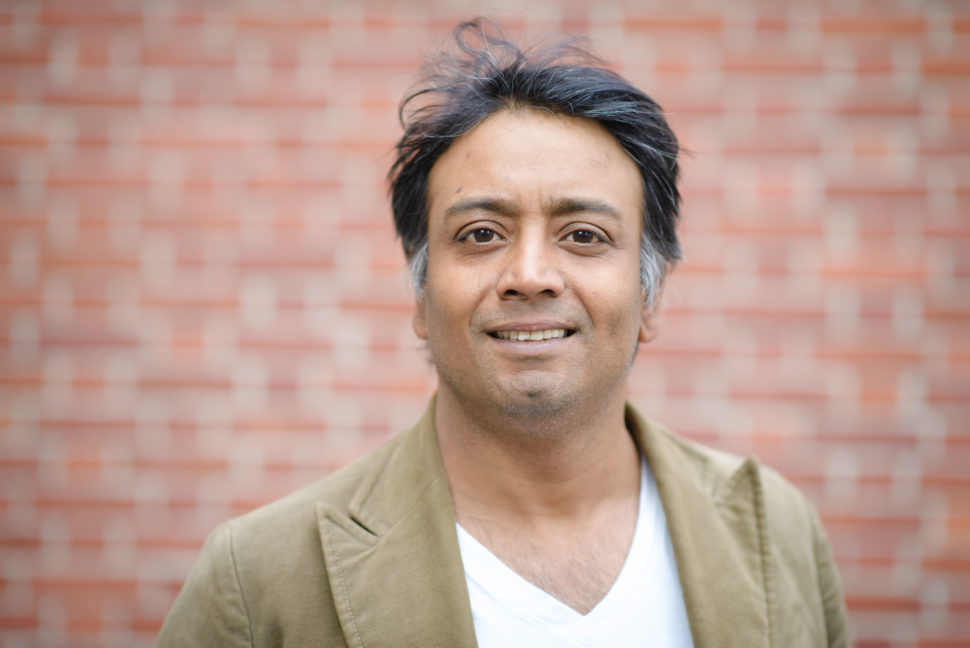
Encounters with Zia Haider Rahman over the years, in the light of big political changes.
Zia Haider Rahman, the Bangladeshi-British author of In the Light of What We Know, winner of the James Tait Black Memorial Prize, shortlisted for the 2014 Booker, and garlanded with a constellation of international awards, recently spent two months in Dhaka. From mutual friends and his mischievously self-mocking Facebook posts (which I am lucky to witness), I gathered that he spent his time learning standard Bangla, researching two contracted non-fiction books, speaking at universities and cultural venues, and posting outrageously funny updates that only he could pull off. I managed to attend just one of his events, his final talk before he flew back to London.
I had read In the Light of What We Know the moment it hit Dhaka bookstores in 2014. Back then, when I heard that ZHR would appear at the Dhaka Lit Fest, I was eager to attend. My colleague Firdous Azim — who was scheduled to be in conversation with him — had only just begun the novel; I had already finished it. She asked if I had questions for him. I don’t remember what I gave her, or whether she asked them.
The auditorium was jammed. I stood at the back. What I remember from that 2014 talk is his admission that he didn’t know standard Bangla — only Sylheti and English. He has said this many times since. He also often mentions that he grew up working-class: mother a seamstress, father a waiter. It’s the same background he gives Zafar, one of the novel’s narrators.
Class — its sting, its memory, its “pernicious” reach — is one of Rahman’s recurring themes. Zafar’s father is a waiter; so was Zia’s. Both grew up in cramped council housing. Yet, to many Bangladeshis, this brilliant Sylheti boy, with his Oxford and Cambridge degrees and immaculate accent, looks more aristocratic than any Dhaka elite. Perception, of course, is its own story.
Over the years I’d forgotten many details of the novel. I remembered the uneasy friendship between Zafar and his Pakistani friend; the dramatic train journey when a twelve-year-old Zafar, dressed in a suit and tie, travelled to Sylhet; and oddly, a scene involving advanced carpentry that impressed Emily’s mother. Bits and pieces remained.
Above all, I remembered being stunned by the intelligence driving the novel, its elegant structure, its expansiveness, the way it threads two men’s personal histories through the seismic events of 1947, 1971, 9/11, and beyond. Gödel’s Incompleteness Theorem, one of the book’s guiding ideas, captures perfectly the novel’s lingering sense of uncertainty.
In the Light of What We Know remains, to me, the finest work of fiction written by a Bangladeshi-British author. I felt that in 2014; rereading it days ago only confirmed it – like opening a bottle you thought you knew, only to find it’s grown deeper, darker, better. And when ZHR casually mentioned, in one of his Dhaka talks, that Fredric Jameson had included the novel on a shortlist of the best fiction of the 20th and 21st centuries, well, there are compliments, and then there is Jameson.
His final public lecture in Dhaka, misleadingly titled “The Politics of Literature” was really an unfiltered critique of the Interim Government. Again in conversation with Firdous Azim, he spoke plainly. Zia speaks truth to power, and, fortunately, can do so without fear.
I suspect a few audience members, now embedded in the Interim Government, shifted uncomfortably as he dissected its failures — particularly those of Dr Yunus and Ali Riaz. According to Zia, Ali Riaz has been a “total disaster,” and the Chief Adviser, on whom so many hopes rested, has failed to create even the minimum conditions for a free press. Good governance, he argued, requires political accountability; the Interim Government has not provided it.
He didn’t hold back. And it was refreshing. Sometimes it takes someone who is both insider and outsider, someone who left, but still cares to say what most of us avoid saying.
In the light of what we know, I’d like to believe that Zia Haider Rahman genuinely cares about the country of his birth. He wrote passionately about the July uprising and initially welcomed Dr Yunus, hoping for symbolic unity. Now he seems more disappointed than optimistic, as the Interim Government continues to stumble through its own missteps.