
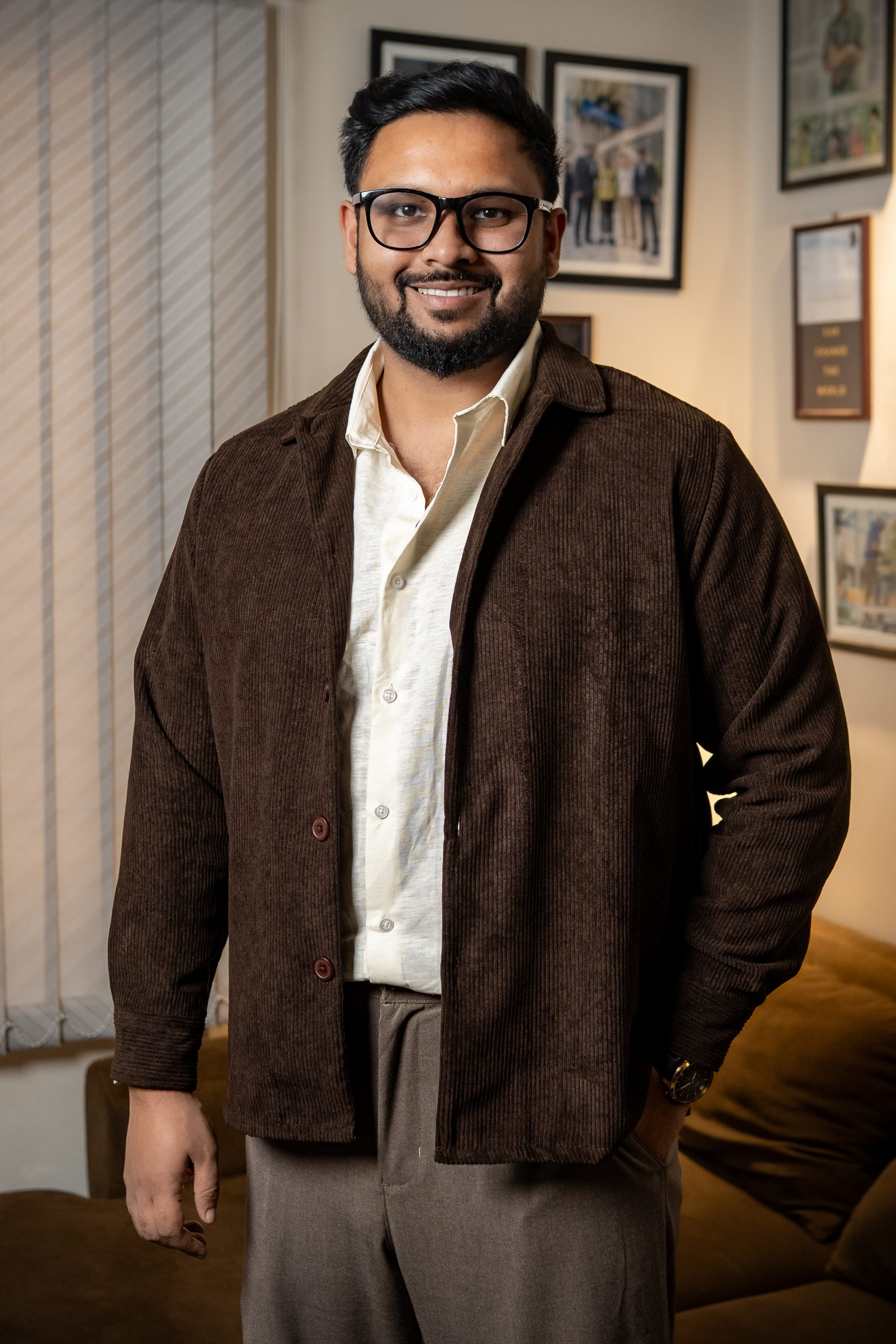
Shah Rafayat Chowdhury has spent half his life on the ground. Now, he’s coming for the policy.
The Footsteps headquarters in Niketon is not the serene, glass-fronted, air-conditioned sanctuary of a typical NGO one might imagine. When I arrive, the office is in a state of high-velocity movement. They are currently mobilising for victims of the Korail slum fire, and the air is thick with the focused energy of a newsroom on election night. As I wait, a young man sits opposite me, hunched over the long table. He is painstakingly working through a list of phone numbers — guardians of students who lived in the Korail slum. He calls each one, his voice a steady anchor in the room, offering study materials and negotiating meeting points amidst the wreckage of their lives. It seems almost improbable that Shah Rafayat Chowdhury has made time for a meeting at all.
Yet, when he finally greets me, Shah Rafayat Chowdhury looks remarkably unruffled for a man who spends his life navigating the literal and metaphorical sludge of the climate crisis. At 29, he is approaching what he calls the “twilight years” of his youth, though he retains the restless energy of the 17-year-old who founded Footsteps in 2013.
We settle into the conversation, and I begin by asking how his definition of “environmentalism” has survived a decade in the trenches. He laughs, recalling a time before Greta Thunberg or the Paris Agreement made activism mainstream. “My friends used to say, ‘You are going to marry a tree when you grow up,’” he shares.
While most of us unceremoniously surrendered our childhood dreams for the predictable safety of desk jobs, Chowdhury spent his twenties staring down an existential crisis and decided, quite sensibly, to get to work. In the twelve years since its inception, Footsteps has matured from a fledgling youth club into an engine for social change that has effectively rewired the logic of impact in Bangladesh.
The numbers are, frankly, startling. Over 800,000 people now have access to safe water and climate-resilient infrastructure because of his team’s intervention. This has been achieved through a series of strategic disruptions rather than simple handouts — from the early democratisation of clean water through Project Trishna, to the community health frameworks of Shushasther Odhikar Sobar, and the poverty graduation models of Project Britto. “Initially, I preferred to be on the ground,” he admits bluntly. “The policy side and the negotiation process were pretty boring to me. But I started to realise I am hitting a limitation.” Ground-level innovation only goes so far without influencing the policies that govern it. This realisation led him from the alleyways of Bangladesh to the air-conditioned halls of COP28 in Dubai.
Every environmentalist has a “why,” Shah Rafayat Chowdhury traces his back to 2023 floods in Southern Feni and Noakhali. While volunteering for rescue and relief work, he broke his left shoulder. A physical price for a lesson in infrastructure. As he struggled to find medical care, he watched the country’s energy, health, and transport systems buckle. He began to see climate change less as a discrete crisis and more as an event that simply takes every fracture in society and forces it wide open.
I ask if his youth ever feels like a stumbling block in a culture that prizes grey hair. He acknowledges the question with a shrug, “People don’t take young people seriously,” he says, “not just in climate action but in regards to everything.” The real evolution, however, has been internal. In the past, a setback might have seen him rush the situation. Today, he no longer fights the door. He focuses his time and energy in analysing the lock. It is a realisation that while he cannot change how the world sees his age, he can change the skill and drive he brings to the table.
He sees the youth label as a strategic asset. In Bangladesh, 40% of the population is young — a massive, informed demographic already bearing the brunt of these events. “Imagine if all of us were united,” he muses. He leans on a favourite proverb, “If you want to go fast, go alone. But if you want to go far, go together.” Through his Changemaker Development Programme, he is already training 2,000 young people to tackle social crises with the same stubborn dedication he started with.
Chowdhury is no stranger to accolades. Along the way, he snagged the Diana Award, the Muhammad Ali Humanitarian Award, a spot on the Forbes 30 Under 30 list — distinctions that, in the world of global development, serve as a shorthand for credibility. Yet, he is quick to clarify that while these honours bring the visibility and funding necessary to scale, they aren’t what gets him out of bed.
“Our biggest award is the work we do on the ground,” he says. He recounts stories of children at the Nayanagar Government Primary School celebrating their new water system, or the quiet shock of people seeing clean water returning to cleared canals, or the quiet revolution of a solar panel finally bringing electricity to a fishing family on Sonadia Island. Chowdhury insists that these moments provide the domino effect of motivation that keeps Footsteps moving forward. It is the difference, he suggests, between a name on a list and a life changed in reality.
Looking out at the Dhaka skyline, the question of survival feels less like a metaphor and more like a deadline. I ask if he truly believes we can pull the city back from the brink. Shah Rafayat Chowdhury doesn’t offer a romantic answer. Instead, he offers a case study. He points to Singapore, reminding me that the city was once a polluted slum before it was systematically re-engineered. Through various projects, he is attempting a similar triage on Dhaka’s suffocating air and stagnant water bodies. He doesn’t think this city is a lost cause, if anything, it’s a poorly managed asset. “If we have that level of influence in decision-making, Dhaka would be a city we could truly be proud of.” he says, his goal isn’t just to make Dhaka habitable, but to see it reborn as a city of gardens. “In the end, it is our city and it is our responsibility.”