
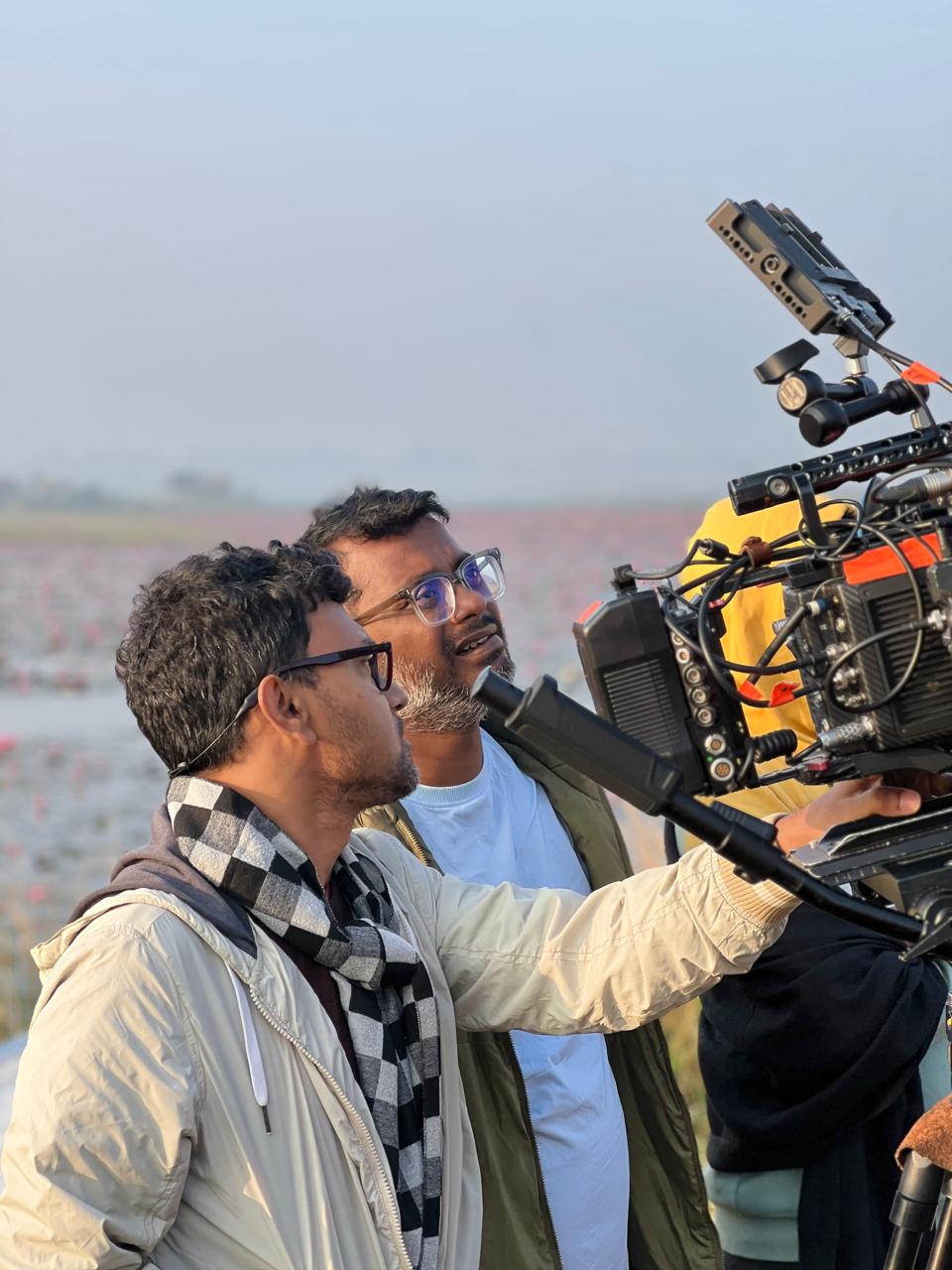
When Ali, a short film directed by Adnan Al Rajeev, premiered at the Cannes Film Festival 2025, it was more than a cinematic moment. It was a culmination of dreams, trust, and years of creative brotherhood. Shot in the picturesque edges of Sylhet in a conservative, tumultuous December 2024, Ali emerged as a 15-minute burst of vivid storytelling, woven from Bangladesh’s own cultural backdrop. The team behind long-term artists of the advertisement scene stepped into short fiction with a kind of intimate precision rarely seen in Bangladesh’s cinematic landscape.
“When I first read the script, I was excited,” said Shihab, who has decades of experience in commercials. “This was my first short film. I was curious. Fourteen to fifteen minutes—such a small window to build a world.”
That window turned literal, as the team—led by Adnan—spent two full months meticulously crafting every detail of Ali‘s world. “Where, for example, a window should be, how the seating should look—we discussed everything. Everyone gave opinions. It was real teamwork,” he recalls.
From the beginning, Ali was more than just a directorial project. It was personal. Adnan’s emotional investment bled into every frame. “We knew this was close to his heart. That made it close to ours, too.”
Building the World of Ali
Visually, Ali is stark and restrained. “We chose a square frame to contain the emotional world. It’s dystopian, almost monochromatic. Browns, greys. Except for one thing, the lotus on the poster. Pink. Just the lotus,” Shihab explains. That contrast was an intentional symbol in a sea of uniformity, the lone blossom of hope or memory.
“We chose a square frame to contain the emotional world. It’s dystopian, almost monochromatic. Browns, greys. Except for one thing, the lotus on the poster. Pink. Just the lotus,” Shihab explains.
Shot over four intense days, the sets were a blend of art and authenticity. The team emphasised rawness, leaning on natural materials and rural Bangladeshi textures. “Our Bangladeshi blankets, our television, our seating under a tree—these are our realities. I try to retain that authenticity while giving Art Direction. I try to work in such a way that my work can be perceived in a subtle way. I try not to overdo my work, so that the audience does not think I tried something tricky.”
Authenticity was not just aesthetic—it was strategic. “The Sylhet area is conservative, and the country was in unrest during our shoot. We had to explain our story during location scouting. There were security challenges. But the story—this linear story of a mother and son—carried us.”
Shihab’s philosophy on art direction is disarmingly simple: observe. “Even when I’m at a railway station or watching chickens in a coop—I’m observing. I want things to feel natural. I don’t want viewers to think the art direction was clever. I want them to feel it was real.”
Despite years of experience in commercials, the transition to fiction felt refreshing. “In ads, the storytelling is different. With Ali, I could just let the space breathe.”
Yet limitations loomed. “We often have budget or time constraints. That’s why we prepare three strategies or contingencies in advance. Communication is key. If I have even 1% doubt, I always check with Adnan Bhaiya.”
That synergy has been built over a decade of collaboration. “We’ve worked together for 10 to 12 years. We know what’s needed just by looking at each other. Same with our cinematographer. That bond—it’s precious.”
Tanveer’s Leap of Faith
For producer Tanveer Hossain, Ali was the result of a long-awaited collaboration. “Adnan and I knew each other for years, but never worked together. Yet I always felt we shared the same creative wavelength. Finally, we decided to start small, but meaningful.”
Tanveer had just come off the success of Radikals—an Asian collaborative project that premiered at Cannes Critics’ Week. That experience paved the path for Ali. “It was like closing the circle. Adnan joined Radikals as co-producer purely based on trust. No questions asked. And for Ali, I wanted him to now bring his own story to life.”
For producer Tanveer Hossain, Ali was the result of a long-awaited collaboration. “Adnan and I knew each other for years, but never worked together. Yet I always felt we shared the same creative wavelength.
What started as a passion project soon became a national moment.
“The screening at Cannes had over 1000 people. They clapped for ten minutes straight. Our faces lit up. We shed tears. It felt like all our years of hard work were finally seen,” Shihab recalls, his voice thick with emotion.
Both Shihab and Tanveer are hopeful about what Ali represents—not just as a film, but as a signal. “This kind of story isn’t told often,” Shihab says. “Maybe we never dared to. But now, with Ali, we know we can.”
Tanveer echoes the sentiment: “This was a beginning, not a peak. It showed us what’s possible when we trust our instincts—and each other.”
For Shihab, the dream has changed. “I want to do more films now. Fewer commercials. I want to work on big fiction. To build worlds that mean something.”
In that dream, a pink lotus floats quietly in the frame—unmissable, unshakable, unforgettable.