
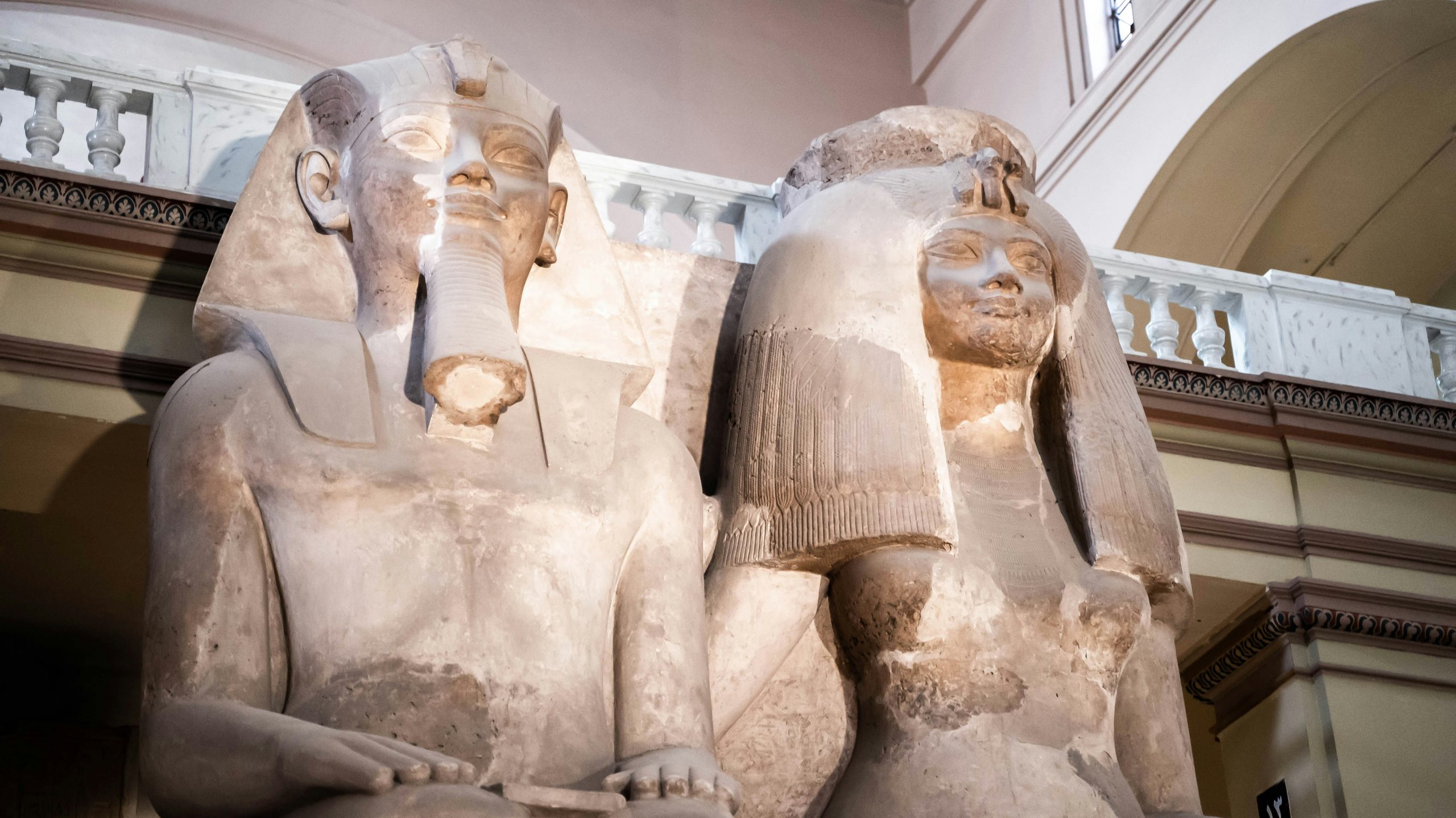
The Grand Egyptian Museum finally opened up to the public earlier this month, after decades spent on its construction and development, which even witnessed a regime change. The opening in these turbulent times sparks conversations about who gets to control the narrative when presenting the history and cultural heritage of a nation.
Abak Hussain
Photographs: Courtesy of 2H Media
“Real museums are the places where time is transformed into space,” wrote Orhan Pamuk. Imagine then, just how much floor space a country like Egypt would need to show off the many layers of its past — the history of a land practically synonymous with the word ancient. What we loosely refer to as Ancient Egypt spans such an incomprehensible amount of time that it is no big deal for milestones to be separated by millennia. When Cleopatra was ruling from her seat of power in Alexandria, the Pyramids were already 2,500 years old. In fact, there is a larger swath of time separating Cleopatra and the pharaoh Khufu (of the Pyramids) than there is between Cleopatra and Hosni Mubarak. Khufu himself was only the second king of the fourth dynasty, arriving something like 600 years after Menes, who is credited with unifying Egypt into a single kingdom. When Menes arrived on the scene to start what we may retroactively think of as the world’s first “nation-state,” the Nilotic civilisation – what we could loosely call “Egyptian” culture — was already a couple of thousand years old.
Here I will stop myself, because if I keep going on about Egyptian history, I risk overshooting the word limit by a pinch. But I think my point has been made. The word “vast” is utterly insufficient to encapsulate the sheer scale of Ancient Egypt’s history, and there is no amount of study that will allow you to master it. Simply getting a handle on the Wikipedia version of the simplified timeline of all 33 pharaonic dynasties will take quite a bit of dedication, and a professional Egyptologist could spend years on the tiniest, most specific part of Egyptian history — say, the era of religious reforms under Akhenaten — and still not be done with the subject.
How, then, can a single museum live up to the task of organising, displaying, and doing justice to this history — all within the confines of government-allocated floor space? I do not envy those who were tasked with bringing this project to fruition, and those who will have to run this behemoth in the years to come. But one thing is for sure — for a country defined by its many eras, the opening of the new Grand Egyptian Museum (GEM) in Giza, just a hop and a skip away from the pyramids, ushers in a new era. This is poised to transform the face of Egyptian tourism as well as scholarly work in Egyptology.
And here it finally is. The Grand Egyptian Museum at long last was inaugurated on 1 November 2025. To think: how many headaches this project has given to people. Quite literally, it took less time to build the Pyramids than it did to take the GEM from conception to grand opening. The vision began back in 1992 when Mubarak’s culture minister proposed an upgrade of the old museum located in Tahrir Square in Cairo city centre, which was falling apart from a lack of maintenance and poor organisation. Then the project went ahead in fits and starts for a while. Then the Arab Spring happened and kicked out Mubarak. Then it was, understandably, one thing after the other which deprioritised the museum. Then came el-Sisi, an even bigger autocrat than Mubarak was, if that’s even possible, and under him the project inched forward.
Now, with 872,000 sq. ft. of floor space, and tens of thousands of artefacts in the collection ranging from early Nilotic settlements all the way down to the Roman period, the GEM is without contest the largest museum in the world dedicated to a single civilisation, and it is hard to imagine any other project surpassing it any time soon.
No doubt, this attraction will bring in knowledge-seekers and selfie-takers from all over the world, boosting the inflow of tourist dollars. On top of that, the government might be hoping for a revamping of its image. A glittering showcase of the glorious past often distracts from the misdeeds of the present. Indeed, Egypt has been busy in burying the true history of its recent past, when rampant human rights violations were committed under the tyrant Hosni Mubarak, and today, while putting up a grand display of ancient glory, the regime under el-Sisi busies itself erasing the true history of the Arab Spring, clamping down on anyone who fights for democracy, equal rights, and transparency.
“My name is Ozymandias, king of kings,” wrote Shelley upon laying his eyes on a giant statue of Ramesses II. The ancient pharaohs saw themselves as gods among humans. To this incredible land, the Nile gave life — but one wonders if there was something else in the water, something that doomed popular uprisings to failure. In Egypt today, the powers-that-be, the new kings of kings, want us to feast our eyes on the old history, marvel at the grandeur and arrogance of kings that are long done and dusted and mummified. In Egypt, the more recent past — the one in living memory — is way too ugly, way too upsetting.
Abak Hussain is a writer and journalist.