
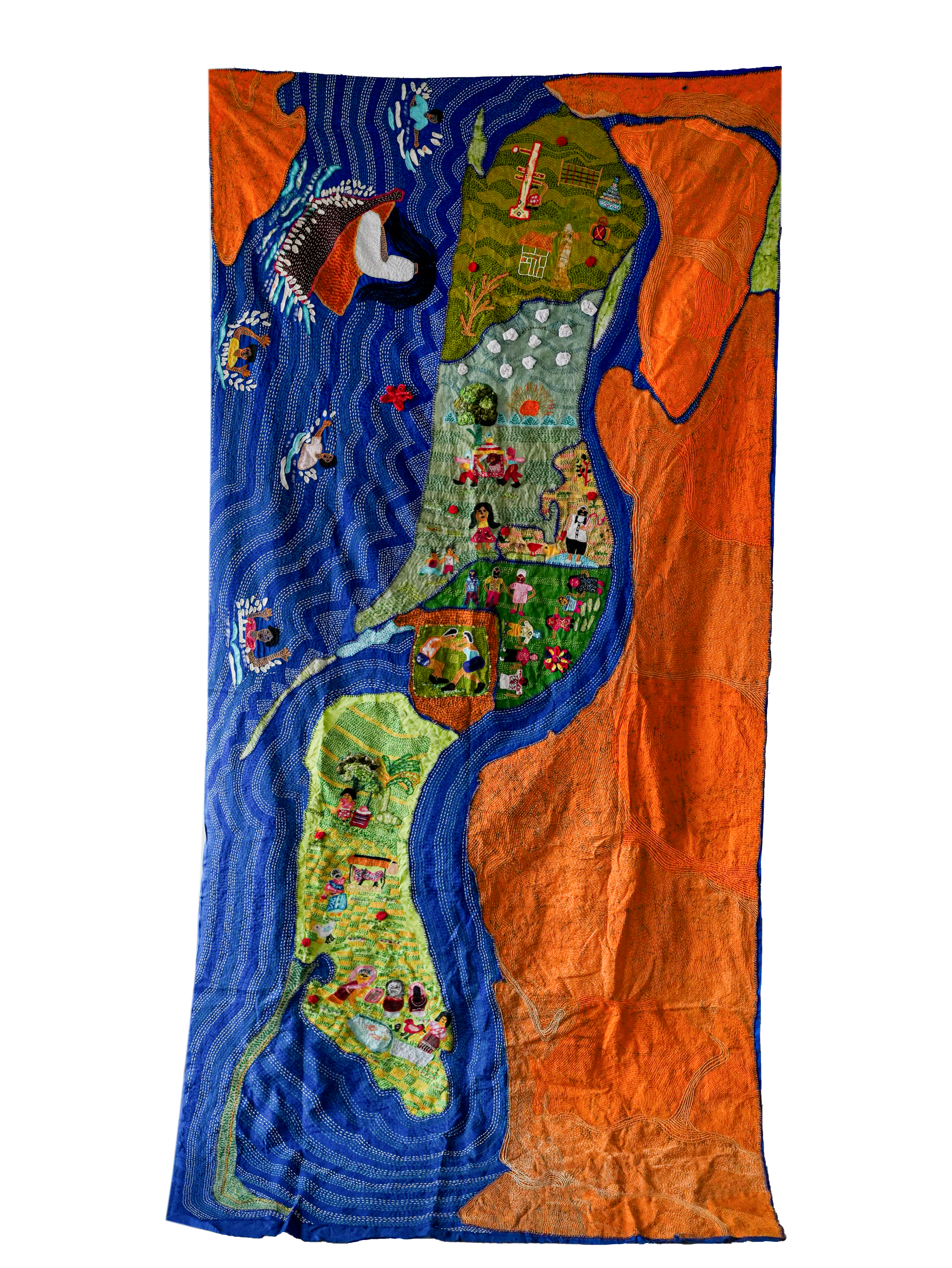
Mahenaz Chowdhury’s archival project, “Matarbari Tales,” built not with paper and spreadsheets, but with textile, fiction, and film, is the irrefutable proof that the community’s narrative always dictates the final history.
In an age defined by monumental infrastructure and global climate anxiety, what, exactly, does resistance look like? And what becomes of a community’s soul when its very home is recalibrated as a $460 billion economic transaction? These are the essential, difficult questions posed and answered by Mahenaz Chowdhury’s extraordinary archival project, Matarbari Tales.
Matarbari, a fragile sliver of land on Bangladesh’s coast, isn’t just facing the usual environmental threat; it is experiencing a profound pivot point. Here, accelerated industrialisation — think massive coal plants, sprawling LPG stations, and entirely new shipping routes — is sweeping away traditional ways of life. This raises yet another inevitable, urgent question: when the land beneath your feet is disappearing, where does memory go?
The answer to that question unfolds over two intense calls and a series of back-and-forth exchanges with the artist and curator, Mahenaz Chowdhury. Confronting the complex reality on the ground, Chowdhury found the community’s view of progress wasn’t what outsiders assumed. “Of course, change is inevitable,” she observes. “The newer generation will always be more attracted to these things, that high-tech, fast-paced life.” But the real surprise came from the older generation, who expressed a unified desire. “They don’t want their children to have the same livelihood. They want their children to get out of that.” The sentiment wasn’t about resisting change, but escaping poverty. Chowdhury, however, saw the urgency of preservation. “I felt that this can’t be the end of this community,” she explains.
Modernisation comes with a price, and is paid in culture. Across Matarbari, the most primitive, traditional practices, for example: the farming of crab, shutki (dried fish), and betel leaf, are slowly disappearing from the land. When a culture is under this kind of pressure, the key to survival is not more technology, but a radical transfer of narrative power. That is exactly the heart of Matarbari Tales. The project, supported by the British Council’s Climate Futures: South Asia 2025 grant, is a complex, three-part initiative, an urgent movement to decolonise memory by giving the narrative authority back to the community — specifically, the women and the youth. Mahenaz Chowdhury starts with the women.
The women, many of whom are now visually displaced by the giant coal plant and deep sea port, have been working with Chowdhury for years. Her long-standing collaboration with them, via her brand Broque and various ULAB projects, centred on preserving their livelihood through Nakshi Kantha. This is the ancient art of creating intricate, story-telling embroidered quilts, passed down through generations. Ironic, that this existing, analogue relationship became the technical foundation for the first digital-age archive: the textile map.
The textile map is, Chowdhury insists, a profoundly subversive act. Over a week-long workshop with Abrar Shadman, the artisans acted as the community’s core memory-keepers, took their traditional craft and radically re-engineered it into not a geographical map charting distances, but a topography of ephemeral memory. The “data” they input was purely emotional, precious, granular details, like the palanquins their grandmothers rode in for their marriages, were meticulously translated and stitched into the fabric. The final, tactile piece is an irrefutable monument to resilience, demonstrating that memory is a commodity far harder to displace than the physical community itself.
If the past is secured in the thread, the future belongs to the pen. The second phase was all about youth leadership, focusing on intensive Story Lab for adolescent students at Matarbari High School, with a clear priority on empowering girls and indigenous youth. The goal here was to bypass the traditional power structures and immediately mint the youth as narrative leaders.
The resulting short stories, including Mohammad Rakib’s The Banyan Tree and Noshin Tabassum’s The Mystery Box, are far removed from typical classroom fiction. Written by the children of fisherfolk and salt farmers, they are de facto literary defence mechanisms. Yet, this act of empowerment is, simultaneously, a burden. By handing them the tools of documentation, Chowdhury is asking these young authors to be the archivists of their own vanishing home. It is an act of necessary pressure, she argues, ensuring that “the lived moments of its people are not silenced by the spectacle of development.”
This is where the conversation turns to the third and final move — a two-week filmmaking workshop, a full, hands-on masterclass, in collaboration with director Piplu R. Khan and his Applebox team. Chowdhury describes this phase as the ultimate transfer of power, and Khan’s team took it literally. Every single one of the 14 students got a chance to hold a camera and direct, with the straightforward assignment to adapt two of their peer-written stories into short films.
Why film? Mahenaz Chowdhury is glad we asked. She stresses that the writing and filmmaking were designed to work in a tandem. Matarbari, she notes, is constantly in the news, often depicted through an extractive lens — focusing solely on infrastructure and tragedy. “Who holds the camera determines the narrative.” Chowdhury points out. By learning direction and cinematography, the students became the directors of their own truth. What the young Matarbari filmmakers brought, she suggests, was an authenticity that professional eyes often miss, a literal, unmediated view of their own community, a view that is entirely free from the imposition of an outside gaze.
Mahenaz Chowdhury is convinced that the archive needed to be polymorphic — one that speaks through the hand, the voice, the eye, and the written word. The emotional data was drawn from conversations that included speaking not only to the Nakshi Kantha artisans, but also to fisherfolk, farmers, and even local journalists and teachers, focusing rigorously on the last 40 years of community experience regarding land, climate, family values, and culture. The final structure was built to cross-reference the soft memory of the Kantha with the fierce urgency of the youth stories and films, and the critical analysis of the academic publication by Myat Moe Khaing, ensuring the final record is the whole human experience of Matarbari.
The final summation of Matarbari Tales is, perhaps, best understood as a correction. Progress, more often than not predictably excludes the very definition of a place, and that exclusion is its ultimate cost. While the $460 billion transaction predicates a clear value for the land, Mahenaz Chowdhury’s project demonstrates the existence of a value that is structurally excluded from the balance sheet. The tangible result of this intellectual and deeply emotional three-months-long journey — from August to November — will be a small, but vital book, exhibitions in Matarbari and Dhaka, and a digital archive. This is the final, emotional record of what endures, and the only proof that truly matters.