
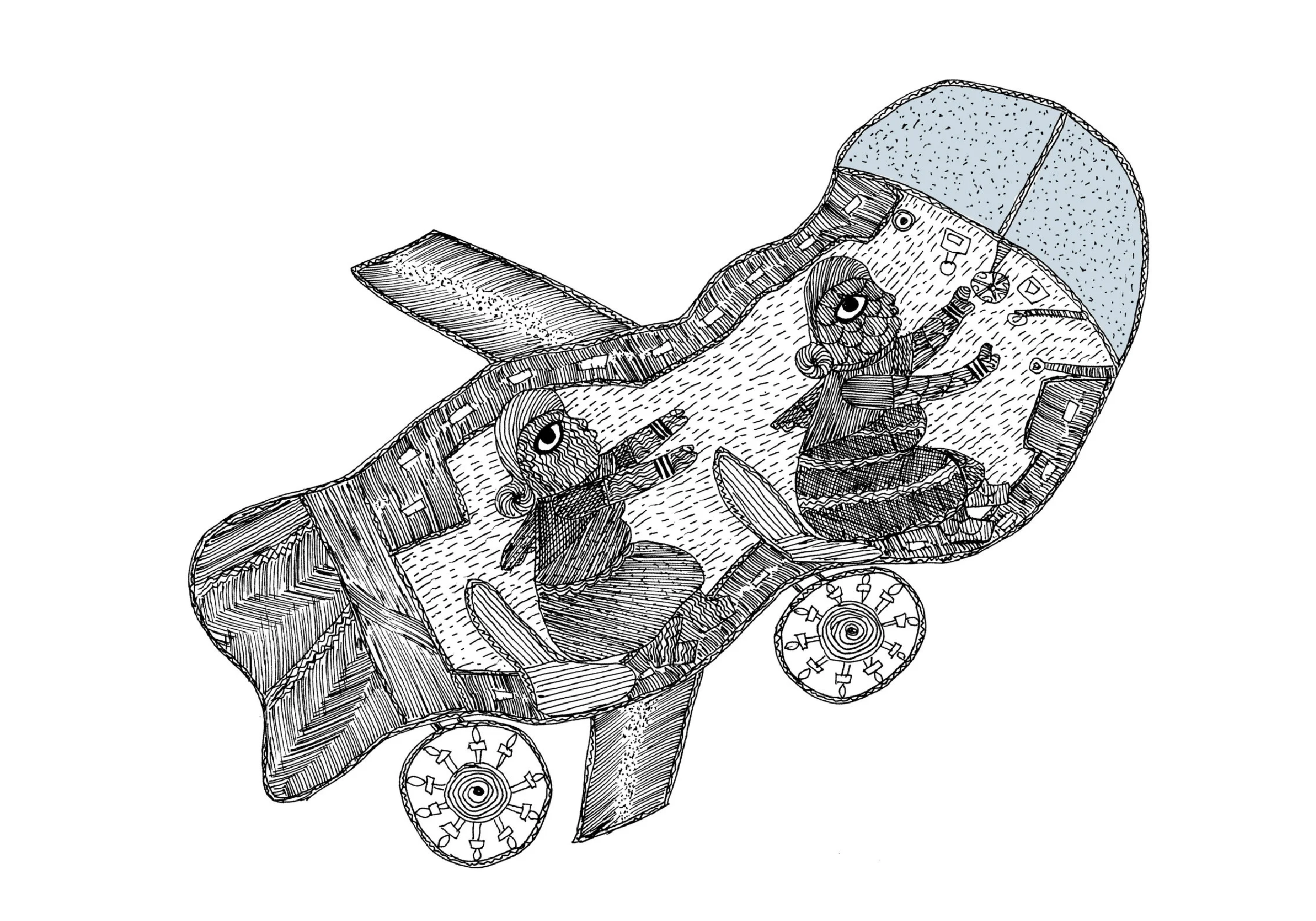
The value and plausibility of Sultana’s solar-powered dream
In Begum Rokeya Shakhawat Hossain’s Sultana’s Dream, first published in 1905, the eponymous character dreams of a country called Ladyland, a matriarchal society where women have full agency over their lives, and men observe seclusion. Women’s education and scientific research is of the utmost import in Ladyland. The Queen is a botany enthusiast who intends to transform the entire country into one huge garden. There are two universities, one which has developed a sophisticated rain-water harvesting mechanism and the other a solar power generation and distribution system. Homes are designed to keep cool in the summer heat. Nobody ever gets sick and the mosquitos don’t bite.
Often dismissed as juvenile, if not completely ignored by Bangladesh’s readership and literary establishment, science fiction has the unique ability to serve up a glimpse into the past, present and possible future. More than mere flights of fancy, the most enduring of these tales are reflective of zeitgeists their authors lived through. H. G. Wells’s The Island of Doctor Moreau, for instance, is a searing indictment of the growing popularity of Darwinian “survival-of-the-fittest” rhetoric, and the murky ethics surrounding the dissection of living animals to advance medical science in late 19th century-Britain. Mary Shelley’s decision to set Frankenstein on a ship stranded in ice on its way to the North Pole was likely inspired by accounts of the real, often doomed arctic expeditions being carried out at the time.
Similarly, Sultana’s Dream stemmed from Hossain’s frustrations with the draconian societal constraints imposed on women, not just in Bengal where she was born in 1880, but the world over. But that’s not all. Ladyland’s solar-powered cookstoves and energy distribution system might have been inspired by real scientific breakthroughs such as the first solar oven, which was invented in 1767 by Swiss scientist Horace-Benedict de Saussure, and Einstein’s 1904 discovery that metal exposed to sunlight can conduct electricity. Solar power, as it turns out, has been around much longer than most of us thought.
Authors like Hossain, Wells, and Shelley do not create grotesque creatures and extraordinary worlds to serve as whimsical entertainment for frivolous minds. Rather, they do it to prompt readers to be more critical of themselves and the world they inhabit. Wells and Shelley’s works were cautionary tales about the consequences of man’s hubris and disregard for humanity in their pursuit of progress, a problem still prevalent today in 2026 as a handful of tech billionaires consolidate power at immense cost to the rest of us.
Hossain conjures a world that is more utopian than Wells or Shelley’s — one where technology is developed and used responsibly, not to bolster any one person’s ego, but to benefit society as a whole, thus daring readers to imagine the possibility of a brighter, more sustainable future. 121 years after the publication of Sultana’s Dream, as the continued use of fossil fuels drives up global surface temperatures, and natural disasters increase in frequency and severity, a system-wide transition to solar and other renewables is not only necessary, but also well within reach.
The International Energy Agency (IEA) expects renewables to be used for roughly 45 percent of global electricity generation by 2030, with solar power making up 80 percent of growth in renewable power capacity. For several years running, renewables have proved to be more cost-competitive than fossil fuels, with 91 percent of all new renewable facilities delivering power at a lower lifetime cost now than the cheapest fossil-fuel alternative. The International Renewable Energy Agency (IRENA) reports that countries were able to avoid an estimated $467 billion in fossil fuel costs in 2024 thanks to renewables.
In Bangladesh, where the lion’s share of solar capacity is concentrated on industrial sites, solar power only makes up 5.6 percent of the overall energy mix. In June 2025, the Interim Government set a goal for renewables to meet 20 percent of Bangladesh’s electricity demand by 2030, and 30 percent by 2040. A National Rooftop Solar Program has been formulated to achieve this goal.
The program constitutes of two initiatives: the first to install rooftop solar panels on all government offices, and the second to do the same for government-run educational institutions, vocational and madrassa facilities included, and public health facilities. Though a deadline for these installations is conspicuously missing, and a change in government may see the entire program scrapped, the initiatives themselves are on the right track. With enough administrative will, focusing on public facilities means faster compliance and nationwide, urban and rural deployment of solar technologies. This will enable implementing authorities to streamline solar installation so rollout is efficient when the program eventually expands to cover privately owned buildings.
Exposure to solar technologies — witnessing their day-to-day operations, monitoring and maintenance, perhaps even participating in it — creates opportunities to build widespread awareness about climate change, cultivate knowledge and develop expertise among two groups poised to shape Bangladesh’s future — its administrators and youth.
Climate change is a multidisciplinary issue spanning environment, energy, economy, industry, urban planning, agriculture, water resources, public health and more.
Administrators working in different ministries and agencies need to be well-informed about climate change and how to mitigate and adapt to its impacts so they can integrate climate concerns into their respective responsibilities, and coordinate with other ministries for effective results.
For young people, seeing solar technologies firsthand can help them understand climate change as a problem they can play an active role in solving. It can inspire a sense of civic consciousness to live more sustainably, and prepare them for an ever-evolving job market, which is seeing a growing demand for high-skilled (engineers, data scientists, finance and policy specialists), medium-skilled (electricians, welders, tower climbers, solar installers), and administrative workers across the renewables value-chain.
Globally, women’s participation in the renewables sector is still a measly 32 percent, and they predominantly work administrative jobs. Early exposure to solar technologies at school can potentially inspire Bangladesh’s girls to pursue more technical jobs in the field.
In Sultana’s Dream, Ladyland’s solar power system is born from healthy competition between the country’s two universities, an environment that encourages research and innovation, and, of course, a society that empowers women. Bangladesh’s National Rooftop Solar Program has promise, but it must be accompanied by enabling policies to reap the full extent of societal benefits it can yield. The program’s training component must extend to administrators, teachers and students, and be tailored to their long-term academic and professional needs. Barriers against women’s education and work must be addressed.
Most importantly, systems of governance and education must be reformed to embrace and support critical thinking, curiosity and creativity, so that, like Begum Rokeya Shakhawat Hossain, everyone can take stock of their circumstances and dare to work towards a better future.