
 The way a museum is curated tells a story. We compare the approach of three museums to the story of our Liberation War
“Histories are written and rewritten, but visual history cannot be rewritten,” said celebrated photojournalist Raghu Rai. This idea, of course, is now being contested in the age of AI, but perhaps still applies to physical artefacts. Poised as we are at this potentially transformative juncture between a revolution and an election, I decided to revisit three of our museums for insight into how national narratives get rewritten.
Bangladesh Military Museum
We started with the newest of the three. This bad boy was born inside the Dhaka Cantonment and went by the name Toshakhana Museum before moving to a sweet location right next to the Novo Theatre on Bijoy Sharani. After an intense glow-up, it formally reopened to the public in 2022.
Occupying a whopping 9.3 acres of land, the museum has a sparkling geodome and a lush green space to match with its next-door neighbour, designed in a way to prevent it from becoming a heat sink.
Inside the museum itself, there are six sections. You start with the Bangladesh History Gallery on the ground floor, and can go up to view the Army, Air Force, and Peacekeeping galleries respectively, or go down to the basement for the Navy gallery. Each section houses models, replicas and artefacts corresponding to the military branch it represents. The carefully considered incorporation of AR, VR, scale models, LED projections, and more makes each section wonderfully immersive and is a great choice for field trips.
The story that this museum upholds is of the nation’s military might and commitment to peace. The excellent accessibility features: parking, wheelchair ramps, and elevators, might make it seem like an inclusive experience, until you pay attention to the narrative behind the curation. Despite a not-insignificant presence of women in the nation-building process throughout our history, and – it has to be said – the upgrades were greenlit by a woman, women are conspicuously absent in the exhibition.
So while the Bangladesh Military Museum rates high on the high quality of its amenities, the story it wants to tell fails the Bechdel test.
Liberation War Museum
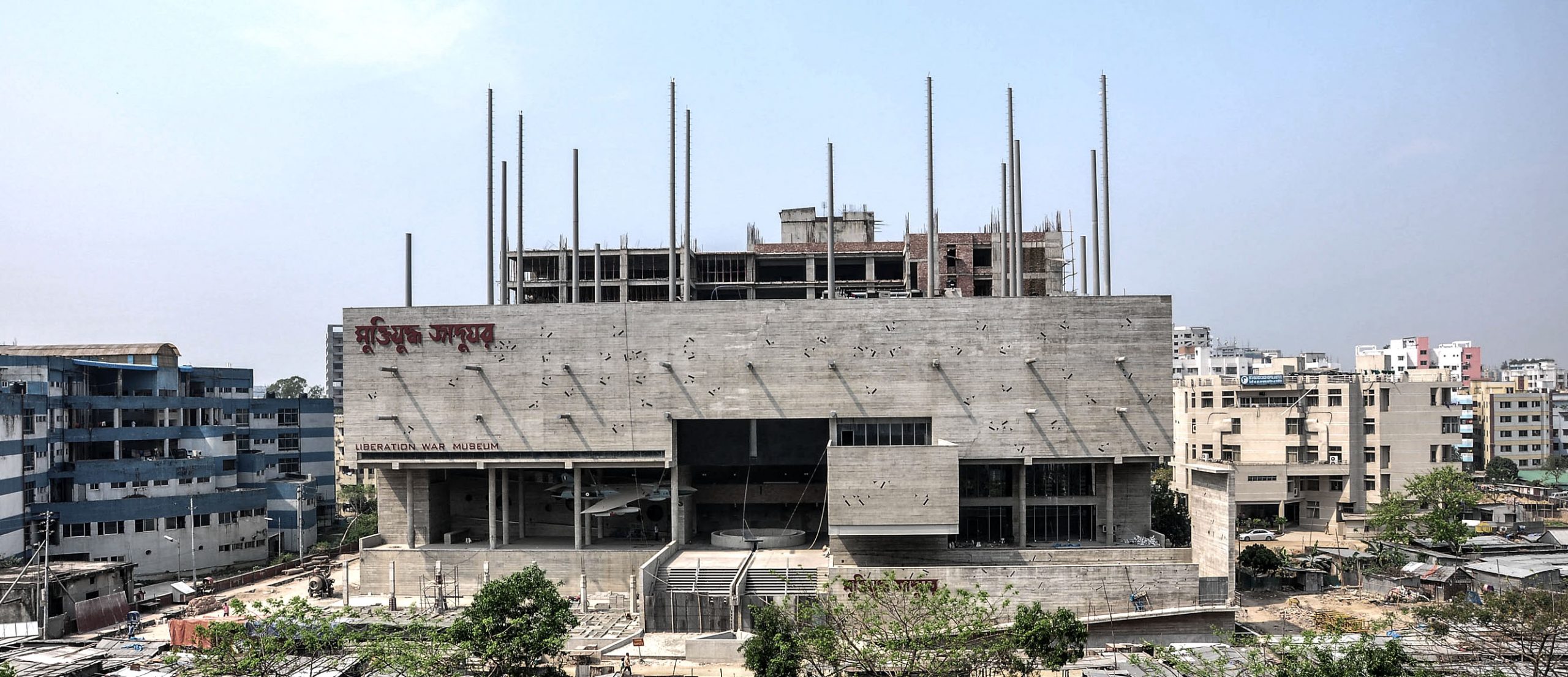
There’s something0 touching about how this museum started in a pretty two-storeyed colonial building in Segun Bagicha and crowd-sourced its artefacts in an attempt to preserve the history of our struggles. As the collection grew, the old location, whose six galleries could barely contain the 1,500 pieces on display, was outmatched by the 21,000 artefacts amassed by its authorities. After a design contest in 2009 settled on a winner for the new look, an acre of land was acquired in Agargaon, and the Liberation War Museum moved to its new location.
The building, built like a giant concrete warship, makes clever use of depth and perspective to create the illusion of grand scale. There are four spacious galleries, and when one follows the signs, one moves through a smooth narrative that begins in the pre-colonial times and arrives at the end of the war. De-centring the role of any particular individual from the narrative of the Liberation, there were some thoughtfully curated installations, such as the use of excerpts from Munier Chowdhury’s play Kabar next to the displays of mass killings of intellectuals in 1971, or the sculptures in the segment on the refugee camps. And no, women were not absent from this story; from photographs to physical objects previously owned by female freedom fighters, politicians, and celebrities, to a whole section dedicated to the Birangonas, the Liberation War Museum, though not as shiny and exciting as the Military Museum, does not count out half the population.
This is not to say that there were no conspicuous omissions. In response to the backlash against the downplaying of the Bihari massacres, the museum seems to have avoided the topic entirely in its new iteration. Also notable was the lack of any references to Kazi Nazrul Islam; in contrast, Rabindranath Tagore remains a significant presence.
If the Military Museum is a tale of battles and glory, the Liberation War Museum is an emotional remembrance of fallen heroes and haunted survivors.
Bangladesh National Museum
One cannot do a museum run in Dhaka and not visit the OG of them all, the National Museum. An idea that was proposed as far back as 1855, and went through several iterations before finding its feet in Shahbagh in 1983, the Bangladesh National Museum is now housed in a four-storied building with a total floor space of 202,116 square feet. As of 2017, the institution has amassed some 91,287 artefacts and is considered one of the largest museums in South Asia.
Not much has changed in the decades since its establishment, and there is a sense of a throwback to analogue times as one walks the massive halls of the museum. Compared to the other, newer museums in the city, this one lacks the razzle-dazzle and easy accessibility, although with innovations such as the 360-degree virtual gallery, there seems to be a move towards the future.
The collection at the National Museum preserves priceless artwork and artefacts of ethnological interest, and has a strong emphasis on natural history and conservation. Moving through long galleries with detailed dioramas, the story of Bangladesh as written by this museum transcends human conflict and reminds us of the vastness of the natural world, the richness of our cultures, and that at any given point in time, we are merely a stitch in the tapestry of a history that is bigger than ourselves. Even the exhibit about the Liberation War, when one finally arrives there, has a larger collection of photographs of mass rallies, refugee camps, prisons, and the aftermaths of battle scenes, deferring to the collective as opposed to individual players.
In the end, what emerges from these three institutions is less a unified national narrative than a set of competing silences and emphases. The Bangladesh Military Museum dazzles with its polished surfaces and triumphal tone, yet risks reducing history to spectacle. The Liberation War Museum gestures toward wounds that remain unhealed, but leaves conspicuous absences in its account. The National Museum, by contrast, turns away from individual heroics to immerse visitors in the textures of collective life. Taken together, they reveal that Bangladesh’s museums are not simply repositories of memory, but battlegrounds of meaning — places where remembering and forgetting are equally deliberate acts, and where the nation’s story is told as much through what is displayed as through what is withheld.