
It was a bright, sunny morning in Kunshan, China, but my mind was on the call I was about to have with a familiar guest. After trying to work around the mechanisms of a VPN to make a WhatsApp call, the ring finally went through, and my laptop screen flickered to life. There she was, Chef Kishwar, warm and beaming as ever. The last time we spoke, nearly three years ago, Kishwar was moving through a whirlwind of world travel and cooking in coveted kitchens. This time, the centre of our conversation is her most anticipated project yet: her cookbook.
For anyone who remembers Kishwar’s journey on MasterChef Australia (Season 13), the ambition had always been clear. In her audition round, when Judge Melissa Leong asked, “What is the dream here?” A tearful Kishwar explained that she dreamt of writing a cookbook centred on Bangladeshi flavours – not just for the world, but for her children, Mika and Seraphina. ”If I don’t do that for them, it’s going to end with me,” she shared with judges Melissa Leong and Jock Zonfrillo. “I really want to pass that down.” Though Kishwar called it a very small dream, Melissa Leong countered that it was, perhaps, a very large one too.
And now, finally, that dream exists in real life. Her debut cookbook, Smoke Rice Water, is a wide-ranging exploration of Bengali cuisine. The title is drawn from her iconic MasterChef finale dish, Smoked Rice Water, a reimagining of panta bhaat.
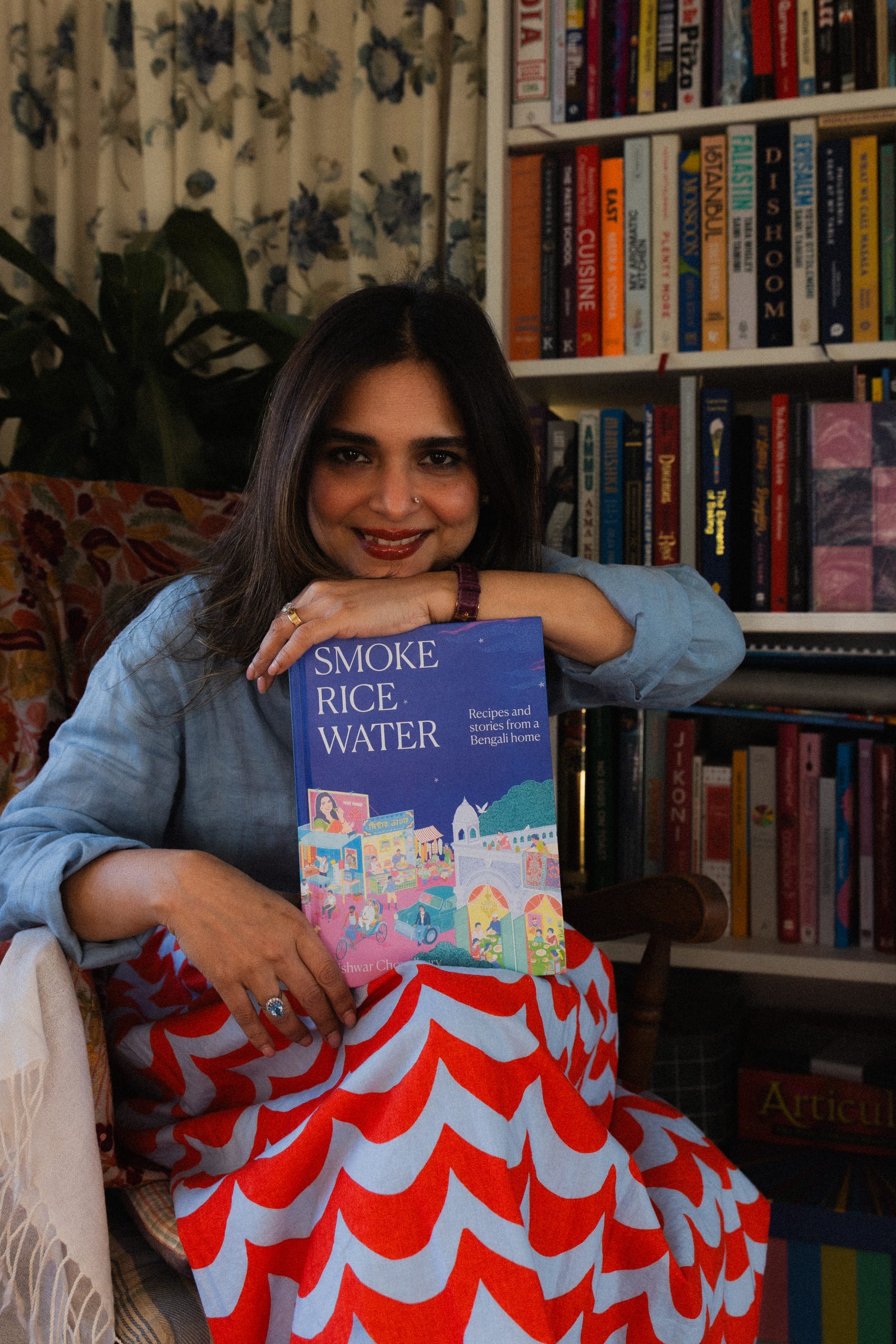
Across the screen, she holds up a sample copy sent to her by her publishers, smiling as she shows it to me. Her excitement is unmistakable, but it is a joy hard-won. “Five years ago, right after the visibility from MasterChef, when I first pitched this book, publishers told me a Bengali cookbook was too niche. They asked if I was sure I didn’t want to do more broad Indian cooking,” she says, letting out a quiet laugh. “I turned down the only offer I had at the time because I believed in this so deeply,” she adds. It was that refusal to compromise is what eventually led her to Hardie Grant Publishing. The cookbook is, in many ways, an extension of the argument she was making that night: that Bengali food is worthy of serious attention, and that “ordinary” is not the same as “lesser.”
Structured across nine chapters, the cookbook traces the many influences that have shaped this cuisine over centuries, from Mughal kitchens to British colonial traces. Each chapter is built around a different historical and cultural layer, mapping how techniques, ingredients, and everyday dishes have travelled, adapted, and settled into local kitchens over time.
For Kishwar, capturing this range was essential; she also wanted to challenge the reductive idea that Bengali cuisine is “all curry,” something she found frustrating. “We have our bhaji that is stir-fried, our bhuna that is braised, and our roast that is truly roasted in a tandoor,” she explains. These methods, she says, are proof of the vast history and influence layered into this small piece of land.
The cookbook opens with a chapter on Chaa Nasta, the quintessential culture of tea and snacks that we all are familiar with, where the fingerprints of British colonisation are still visible in beef patties and baked goods. Then, there’s a chapter called Nawabs of Bengal that unpacks the Persian thread running through the cuisine. “The kebabs, naan, and halim we see on our streets, the korma and nargisi kofta – these all stem from that influence,” she explains. She also looks further afield in a chapter titled
Further East, tracing 600 years of trade with neighbours like China, Nepal, and Bhutan. “That is where Bangla-Chinese was born; these recipes for wontons and yellow fried rice are centuries old,” she says.
She also points out that some of the recipes in the book are ones you simply won’t find in a kitchen in Bangladesh or India. There’s a recipe for Tuna Kabab, a dish that has quietly become a staple in the diaspora like that of in the UK and Australia. It exists because Cheetol maach, the fish traditionally used for Kofta, is nearly impossible to find abroad.
But documenting a culture that exists across so many borders is a heavy task, particularly when the politics of identity are so fraught. During our conversation, Kishwar is candid about the difficulty of the task she set herself with this project. “If you want to write about the truth, you have to do it regardless of the politics,” she tells me. This meant documenting the ethnolingual reality of Bengal that once dominated global trade through its tea and textiles. It is a brave stance to take in the current climate. “I am scared,” she admits candidly, “but it was really important for me to write from a place of reality. Let’s see how that works out.”
This commitment to truth and reality is exactly why the project grew so significantly. Originally commissioned for just forty recipes, the book quickly outgrew its brief. What began as a 30,000-word manuscript eventually expanded into a 90,000-word deep-dive, though even then, she says, it could not hold everything she wanted to include. There are more recipes and stories she wants to share. Smoke Rice Water, by her own admission, is just the beginning.

Getting the visual language right mattered as much to Kishwar as the recipes themselves; she saw the book’s aesthetic as another way to ground the project in reality. To achieve this, she collaborated with a team that understood the nuances of the region: photographers Ata M. Adnan and Rana Pandey, alongside the creative studio DhakaYeah.
Ata M. Adnan explains that capturing the authenticity of everyday kitchens and street life was central to this vision. Drawing from over a decade of photographing Dhaka and Chittagong, Ata dove into his extensive photography archive. “I knew only thirty or forty photos would make the cut, but I sent them like four to five hundred photos that felt appropriate,” he says. “The publishers were shocked to see the variety of photos from Bangladesh.”
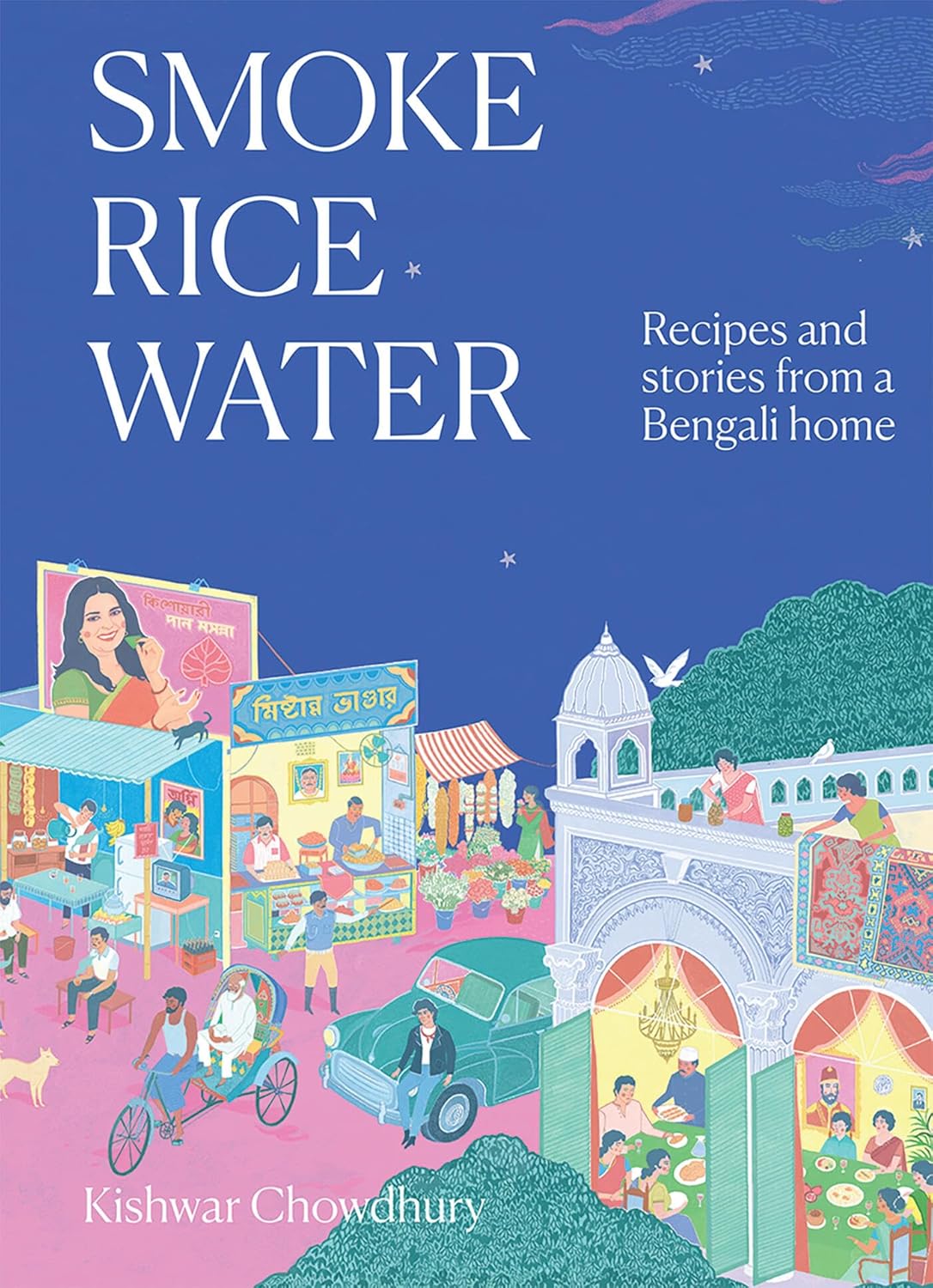
DhakaYeah, who designed the cover and internal illustrations, approached the project with a similar sensibility. Their focus was to “build a composition that felt alive and layered with familiar elements from the Bengali menu, while still carrying DhakaYeah’s distinct illustrative language.”
The result of this collaboration is a book that refuses to settle for a flattened, tourist-friendly version of Bengal. It is a work that insists on being seen on its own terms, proving that the “ordinary” is indeed worthy of the highest level of craftsmanship. It was Kishwar’s conviction that Bengali food is worth the fight that brought this cookbook to life, but for her, the work is far from complete.
As our conversation wrapped up, I asked her what she hopes this body of work will ultimately achieve. Her answer is rooted in a desire to validate what has long been overlooked. Since her time on MasterChef Australia, she adds, the landscape has begun to shift, with more people now shaping and claiming their identities around Bengali food. “If I can show through this book that Bangladeshi and Bengali food is worth writing about, talking about, and publishing, then hopefully it opens the door for more people to enter this space. That’s what I want to see happen.”