
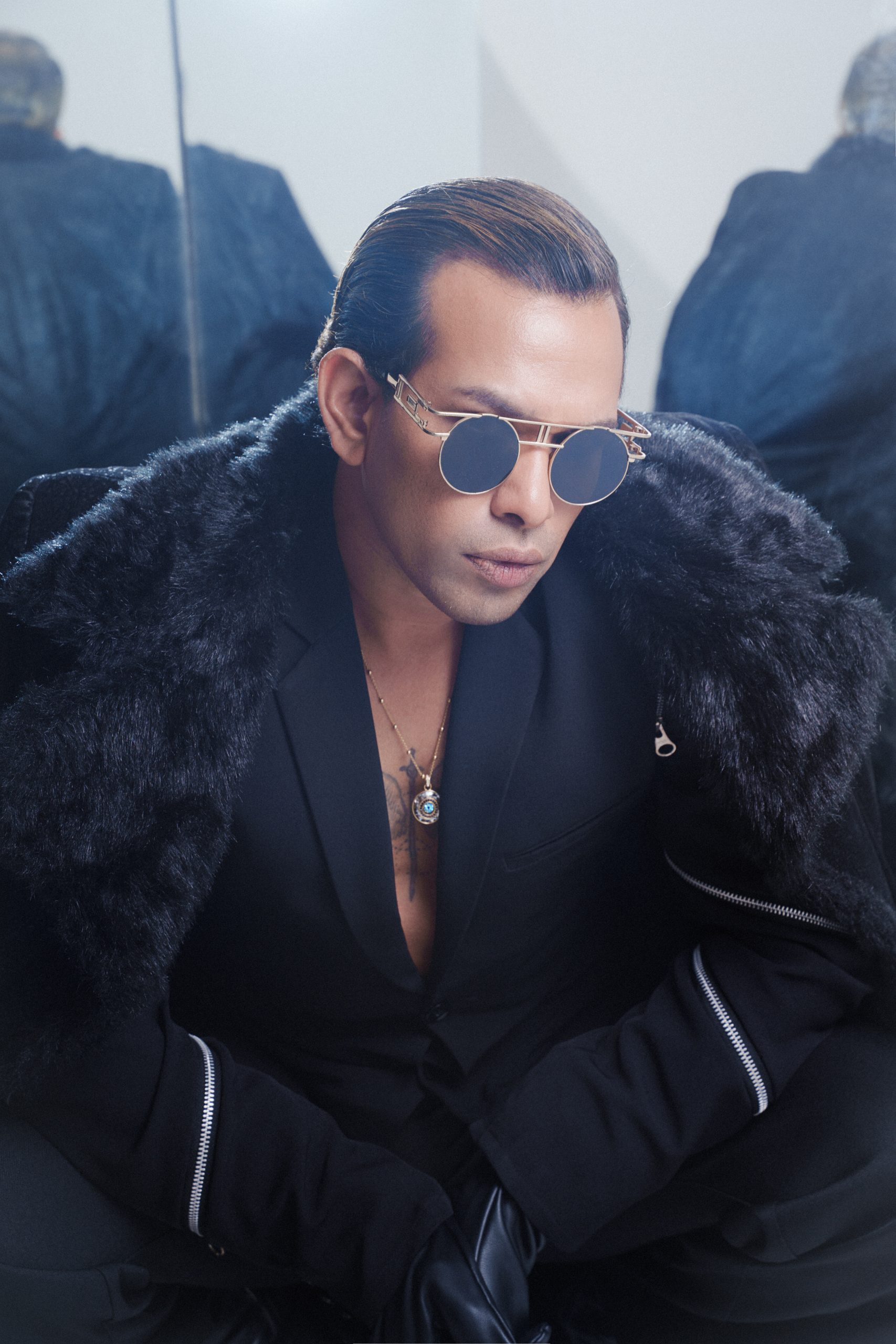
Mahmudul Hasan Mukul arrives without the performance of arriving. No entourage, no theatrics, no carefully planned lateness. By the time we sit down at Bao on a humid afternoon in Gulshan, lunch is already over and the room has slipped into that quieter in-between hour when conversations feel less guarded. Mukul speaks in long, measured thoughts, pausing often to sharpen an idea before letting it land. It is the kind of cadence that comes from someone who has spent most of his life observing.
In Bangladesh’s fashion industry, Mukul occupies an unusual position. Depending on who you ask, he is a creative director, model mentor, fashion editor, designer, educator, or industry architect. The truth is probably all of those things at once. For more than two decades, he has moved quietly through the machinery of Bangladeshi fashion, helping shape the industry and, in some cases, the people who now dominate it. What is striking is how little he romanticises any of it.
You have moved between multiple roles throughout your whole career. Do you see them as separate disciplines, or are they all part of the same visual for you?
When I started out in the early 2000s, these roles didn’t really exist in the way we define them today, but that doesn’t mean the work wasn’t happening. People who were exposed to those early days of the internet, who were keeping up with international magazines and global references, were already doing parts of it instinctively – just without the titles. The industry itself took quite a long time to catch up, I would say around 2009 or 2010 when things started to formalise a bit more.
I began as a fashion designer, but very quickly I realised I was more comfortable working behind the camera than in front of it. That shift naturally led me towards creative direction. At that time, there were only a handful of people working in this space, and it was quite unstructured. Some experiences with senior figures in the industry were not always very collaborative, and I think that is partly what pushed me to start my own model development institute. I felt there was a gap that needed to be filled properly. It’s now been around 18 years now since I started it, and I’m proud to say that a large portion – maybe around 80% – of the models working successfully today have passed through that training system at some point.
Later, when MW Bangladesh Magazine, offered me the role of fashion editor, my priorities were simple. I was only interested in doing it if there was space to push boundaries. Fortunately, they shared my vision, and together we’ve been able to experiment and push things forward in a way that felt honest to both of us.
I have always been very intentional about what I do, and while these roles are all separate disciplines, each one naturally led into the next. One made the other easier, or gave it more clarity.
The Bangladeshi fashion scene has changed dramatically over the past two decades. What do you think has been gained, and what has quietly disappeared?
The Bangladeshi fashion scene has always been largely driven by retail brands. Independent fashion designers have never really managed to build a strong, lasting foothold in the same way. And I think a big reason for that is that retail brands, for all their commercial instincts, have actually been more consistent in building identity. They may not always be experimental, but they know their customer and they stick to a certain visual code. Many designers don’t hold on to a clear visual language. If something is trending at the moment, everyone moves in that direction. Very few people resist that pull long enough to build something recognisable as their own. That’s why a lot of designer work ends up feeling interchangeable. You can’t always tell who made what. The same can be said for many models today.
Still I’m hopeful. I would say there’s far more visibility now than there used to be. I also don’t buy into the idea that Gen Z are somehow difficult to work with. In many ways, they’re actually far more self-aware and communicative than previous generations. Millennials, for example, would often hesitate to say no to a last-minute job even when it disrupted other commitments. Gen Z tends to be much clearer about their boundaries. If a shoot overlaps with a university exam, or they’ve already committed to another project, they’ll say so directly. They’re also far more open when it comes to discussing payment and what they expect to be compensated. I actually find that admirable, and I think the industry benefits from that honesty.
Has being an editor to other people’s work changed the way you look at your own creative instinct?
I think people outside the industry have a very romantic idea of fashion design, but fashion is also business. If you’re designing a collection properly, there has to be balance – maybe fifty percent art, fifty percent commerce. Because at the end of the day, there are investors, production costs, people involved in making the whole thing happen. You cannot completely ignore that reality. In real life if the collection doesn’t sell after months of hard work, it feels terrible. I don’t think I was ever very good at that balance, honestly. My instinct always leaned more emotional, more instinctive. So eventually I moved away from it.
But I genuinely loved those years. My clients were very loyal, mostly word of mouth. I didn’t have any walk-ins. The people who came, came because they connected to the work personally.
Recently I was at an event and someone was wearing one of my old pieces. I was staring at it thinking, “Wait… I made that.” Then she asked me when I’m returning to designing again. So who knows. Maybe I will. But if I do it, I think it would be in a way that feels lighter and more personal, like a capsule collection.
After everything the industry has given you, and taken from you, what are you choosing to carry forward into the future?
I think at some point you have to decide whose voice you’re going to live by. Mine was always my own. I’ve never been very good at listening to other people. If you’re not harming anyone, then live unapologetically. That approach confused some people, irritated others, but honestly, it served me well. I’m actually quite satisfied with my work. I did what I wanted to do. I worked the way I wanted to work. And I think I gave something to the industry also, in my own way.
But if there’s one thing I sometimes think about, it’s this: I wish I wasn’t so hard on myself. I started working very young. At an age when people are usually hanging around tea stalls near university for hours, being stupid with friends, I was already busy with campaigns and deadlines and clients telling me, “Amazing work.” Which is nice, of course, but I think I skipped a certain kind of youth.
You don’t realise it at that age because you’re too busy chasing independence. I wanted to earn, I wanted to create, I wanted my own space. But later you understand there are some experiences you cannot recreate once time passes.
I think because of that, this phase of my life is less about proving something and more about experiencing things. I travel more now. I am trying to say “no” to work more often. Inspiration doesn’t always come from fashion – sometimes it comes from a conversation in a random city, or sitting somewhere unfamiliar with no agenda.