
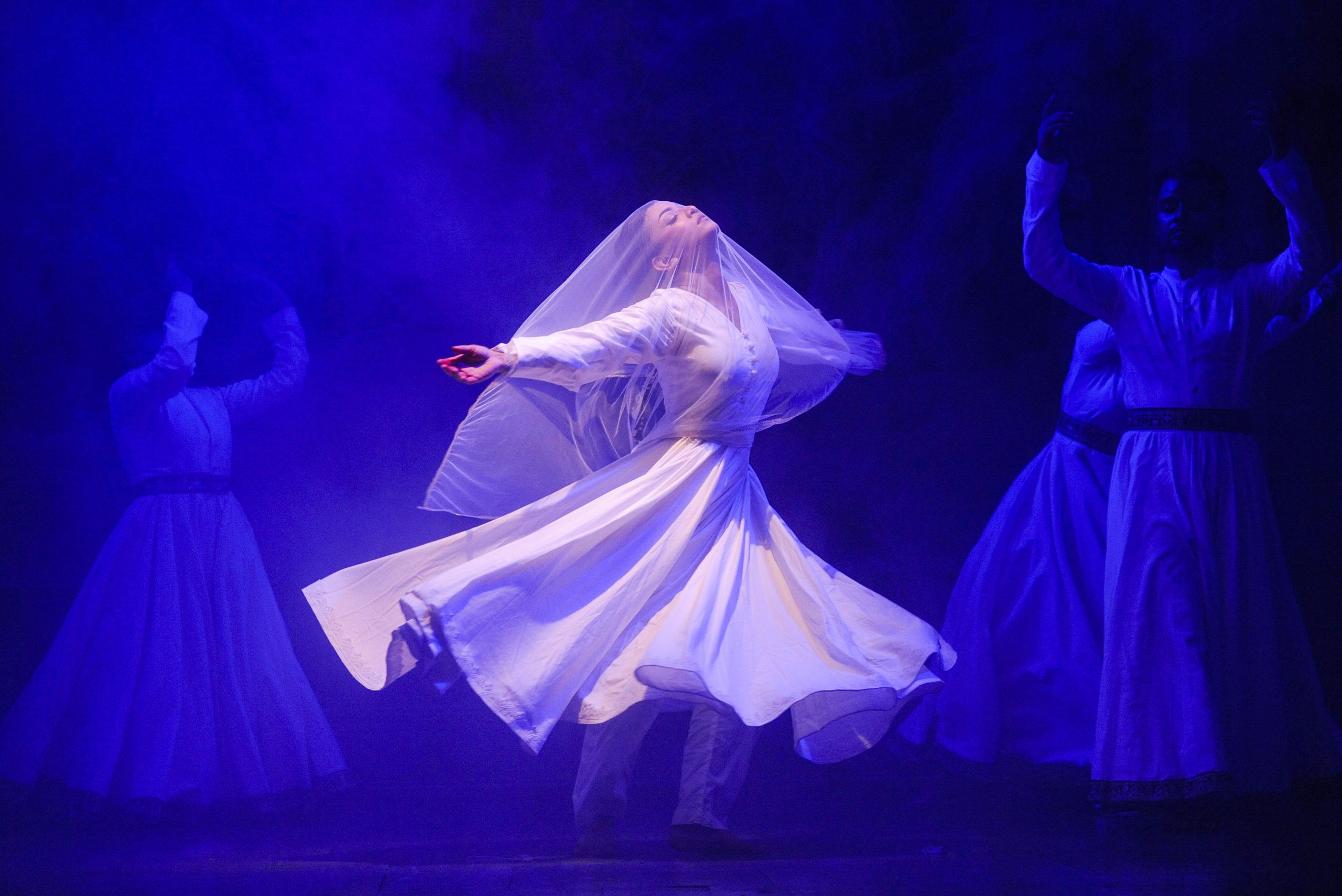
Shadhona’s Dilnawaz transforms a forgotten Urdu fable into a hypnotic dance drama about love, longing, and spiritual surrender.
Shadhona’s Dilnawaz is the kind of production that stays with you long after the lights come up. Directed by Lubna Marium, the dance drama blends movement, music, and Sufi philosophy into something deeply emotional without becoming overly theatrical. At a time when many stage productions lean heavily on spectacle, Dilnawaz feels refreshingly sincere. It asks the audience to slow down, sit with emotion, and surrender to the rhythm of the story.
The production is based on an Urdu short story written by Rahat Ara Begum, often regarded as the first woman Urdu fiction writer of 1940s Bengal, now a largely forgotten literary voice whose work explored themes of mysticism and devotion. The story follows Dilnawaz, a handmaiden in a royal court who falls in love with a prince she can never truly have. But this is not a conventional star-crossed romance. Her longing gradually transforms into spiritual awakening, echoing the Sufi idea that earthly love can become a path toward divine connection. The story unfolds through seven stages of Sufi love, such as attraction, infatuation, love, trust, worship, madness, and annihilation, each representing the stripping away of ego and self.
On stage, the narrative is less linear. The storytelling leans more on atmosphere and feeling. The production moves almost like a dream. Dialogue is minimal, entirely in Urdu and the choreography carries the emotional weight with surprising clarity. From the opening sequence, the stage feels suspended somewhere between reality and trance. The choreography combines Kathak, Mugham traditions, and contemporary dance styles, creating a language that feels both rooted and modern. There are moments of stillness followed by bursts of spinning movement that make the stage feel alive.
At the centre of it all is Mubasshira Kamal Era as Dilnawaz. Her performance is intense without ever tipping into exaggeration. Rather than simply portraying Dilnawaz, Mubasshira Kamal Era seems to dissolve into the character entirely. The most striking sequence comes during the later part of the production, when Dilnawaz enters the stage of “junoon” (madness). Era spins for what feels like an impossible amount of time. The audience watches in stunned stillness, perched at the edge of their seats as her spinning grows almost hypnotic, the quiet in the room thick with anticipation and disbelief.
What I liked best about Dilnawaz was its restraint. Despite dealing with themes as grand as love, faith, and transcendence, the production never becomes preachy or self-important. A lot of spiritual theatre tends to over-explain itself, but Dilnawaz trusts its audience enough to simply let the emotions unfold. Lighting plays a huge role in shaping the mood, especially in the second half, where deep blues and warm golds create an almost otherworldly atmosphere. The costume design also deserves credit for enhancing the storytelling without distracting from it. There’s a confidence in how the show balances classical influences with modern performance language. Even viewers unfamiliar with Sufi philosophy can connect emotionally because the production focuses less on intellectual explanation and more on human feeling.
Another strength is how committed the performers are to the emotional world of the production. Every movement feels intentional. Even ensemble scenes maintain a strong sense of discipline and rhythm. That level of control is difficult to achieve in dance theatre, where large casts can sometimes dilute emotional focus. Here, the group performances actually deepen the sense of ritual and collective experience.
That said, Dilnawaz is not without its flaws. Some sections in the middle feel slightly overextended, and while the repetition clearly serves a meditative purpose, it occasionally slows the emotional momentum. The production’s heavy reliance on symbolism and movement over straightforward storytelling may also leave some viewers feeling distanced from the narrative, particularly in the earlier scenes where the prince functions more as an abstract idea than a fully realised character.
Still, those are relatively minor criticisms in a production that accomplishes so much with sincerity and artistic confidence. In many ways, Dilnawaz feels like a rare kind of theatre experience that doesn’t rush to explain itself or chase easy applause. It demands patience, and rewards that patience with moments of genuine emotional power. Whether you connect to it through dance, storytelling, or its exploration of faith and longing, Dilnawaz leaves behind the feeling that you’ve witnessed something intimate rather than simply watched a performance.